
The Attorney’s Guide to Family Law Mediation in Florida
Last reviewed: August 2026

Call For Free Consultation
Saturday Appointments Available


Last reviewed: August 2026

Family law disputes often involve deeply personal decisions about children, finances, property, support, and the future. Mediation gives parties a structured opportunity to discuss those decisions with the help of a neutral mediator, instead of leaving every disputed issue for a judge to decide.
This guide explains how family law mediation generally works in Florida, the roles of the mediator and the attorneys, how to prepare, what may happen during a session, and what follows when the parties reach a full agreement, a partial agreement, or no agreement. It covers mediation in divorce, parenting, support, property, paternity, and post-judgment matters without attempting to replace the detailed legal analysis each subject may require.
Mediation is not simply an informal conversation. Decisions made there may affect a family for years. A productive process requires sufficient information, careful preparation, realistic proposals, and a clear understanding of the language placed in any written agreement.
561.530.4568 | grant@gisondolaw.com | gisondolaw.com
Important: This guide provides general information about Florida law. It is not legal advice and does not create an attorney-client or mediator-participant relationship. A lawyer should evaluate the facts, deadlines, safety concerns, and goals in your individual case.
Mediation is a confidential dispute-resolution process in which a neutral mediator helps participants communicate, identify disputed issues, explore options, and work toward voluntary agreement. The mediator does not act as a judge and cannot force either party to accept a proposal.
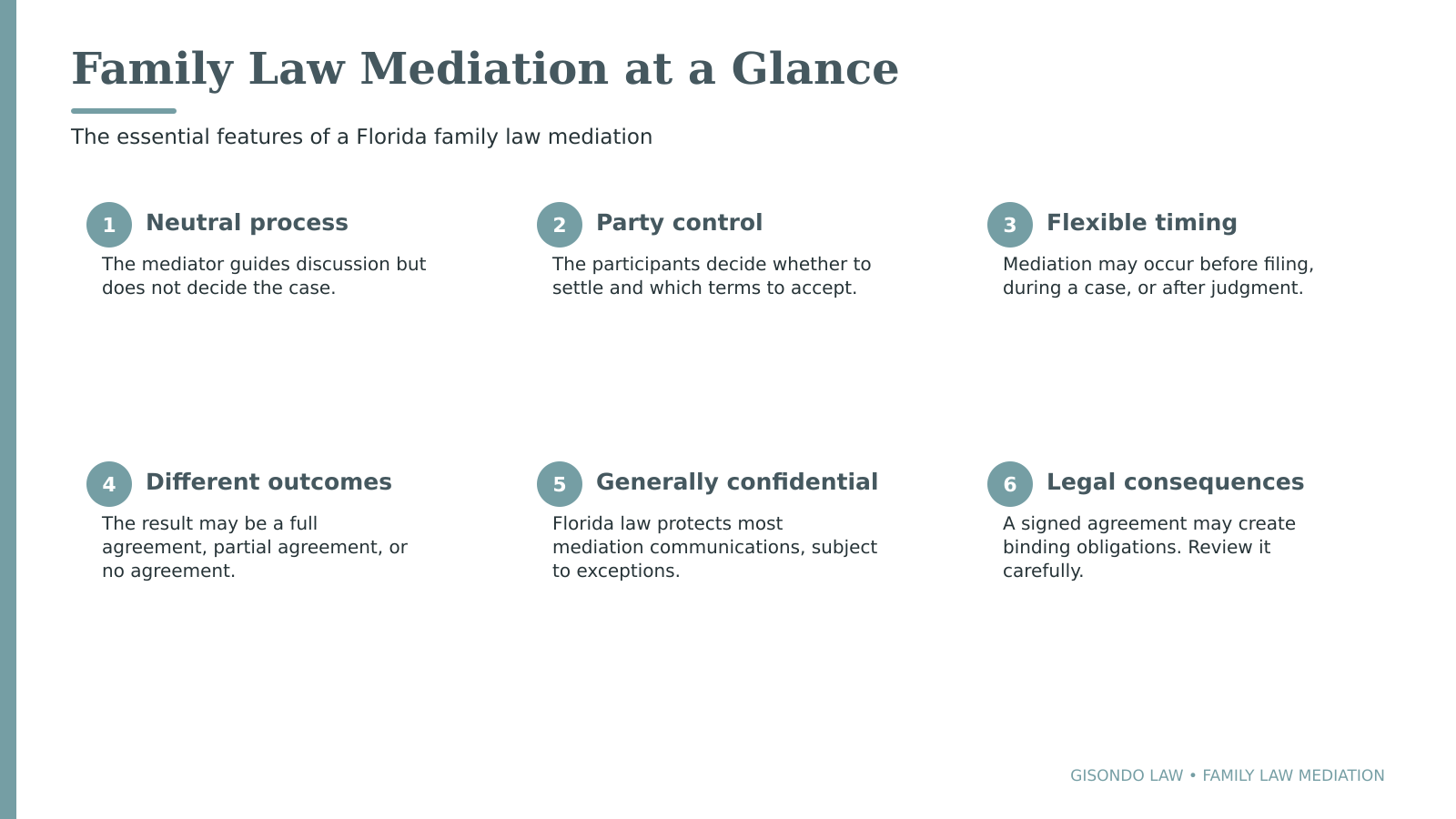
The Florida Courts describe mediation as a process in which a neutral and impartial person helps the parties develop possible solutions, stay focused, and clarify areas of agreement and disagreement. Unlike litigation, mediation is designed around party self-determination: the participants retain control over whether to settle and, if so, on what terms.
For an official overview, see the Florida Courts mediation resource.
The immediate purpose is to determine whether the parties can create an acceptable resolution without asking the court to decide on every disputed issue. Mediation may also narrow the case, improve communication, clarify the evidence needed, or identify terms that can prevent future disagreements. Success does not have to mean resolving everything. A carefully written partial agreement can reduce the issues that remain for trial.
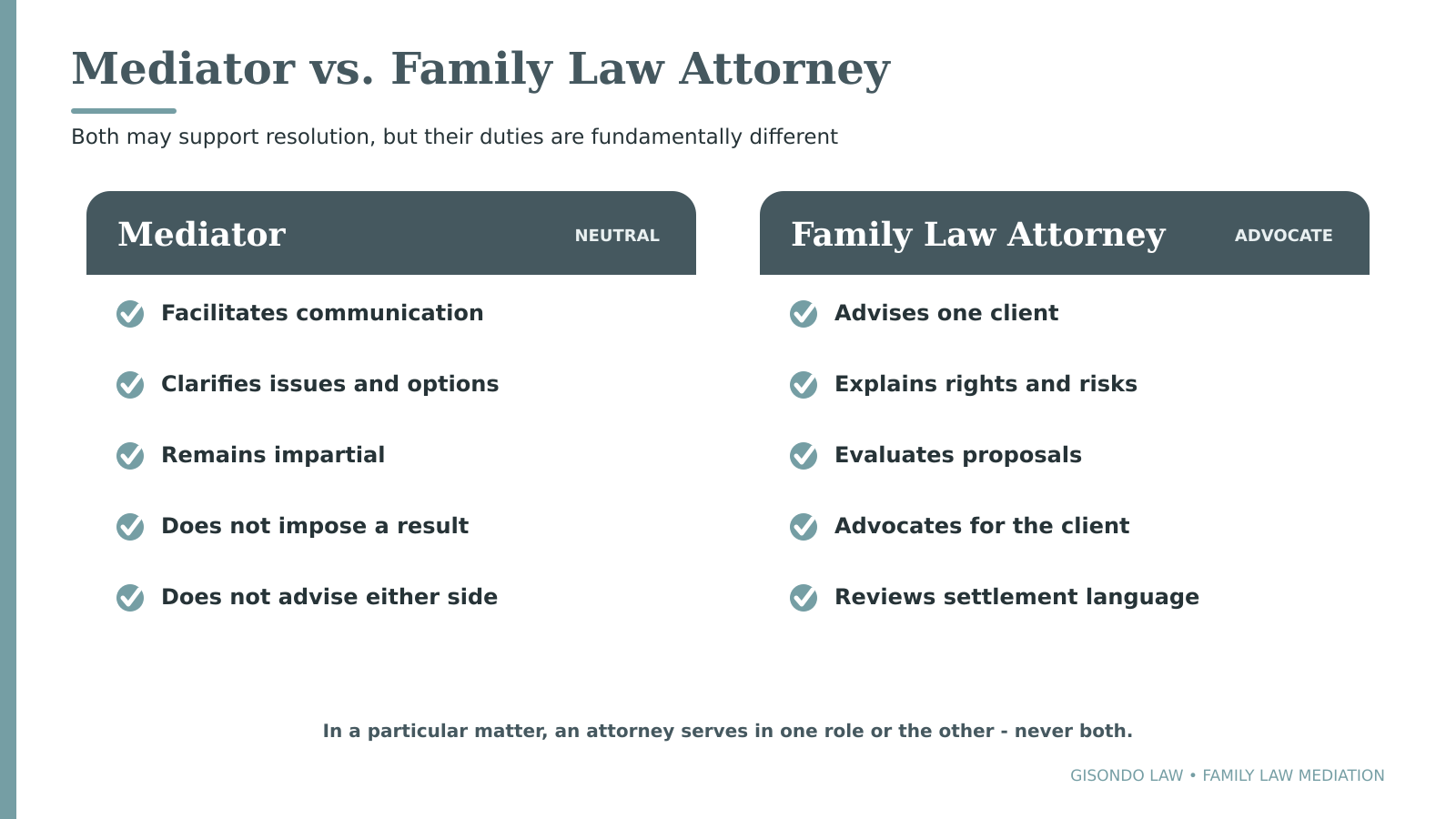
The distinction between a mediator and an attorney is essential. The mediator is neutral and serves the process. An attorney represents one client, explains that client’s legal rights and risks, evaluates proposals, and advocates for an outcome consistent with the client’s lawful objectives.
A lawyer who is also a certified mediator may possess valuable subject matter and negotiation experience. However, in any particular mediation, the lawyer must occupy one role or the other. The neutral mediator does not simultaneously serve as either participant’s advocate.
Parties may choose mediation before filing a lawsuit. Early mediation can help them explore resolution before positions harden and litigation expenses increase. Pre-suit mediation still requires informed decision-making. The parties need enough financial and factual information to evaluate proposals, and each should understand the consequences of signing an agreement.
Mediation frequently occurs while a divorce or other family-law case is pending. At that point, pleadings may have defined the claims; mandatory disclosures or discovery may have supplied information, and temporary orders may already govern the parties. Mediation can address the entire case or selected issues.
Florida Family Law Rule of Procedure 12.740 governs family mediation and permits contested family matters and issues to be referred to mediation except where law or the rule provides otherwise. Local administrative orders and judicial practices may affect when mediation occurs and what must happen before a final hearing. A court order to attend mediation requires participation in the process; it does not require a party to accept a settlement.
Mediation may also help resolve disputes after a final judgment, including properly raised questions involving support, parenting arrangements, implementation of property terms, or enforcement. The underlying legal standards still apply. Mediation cannot create jurisdiction or lawfully waive protections that the parties are not permitted to alter.
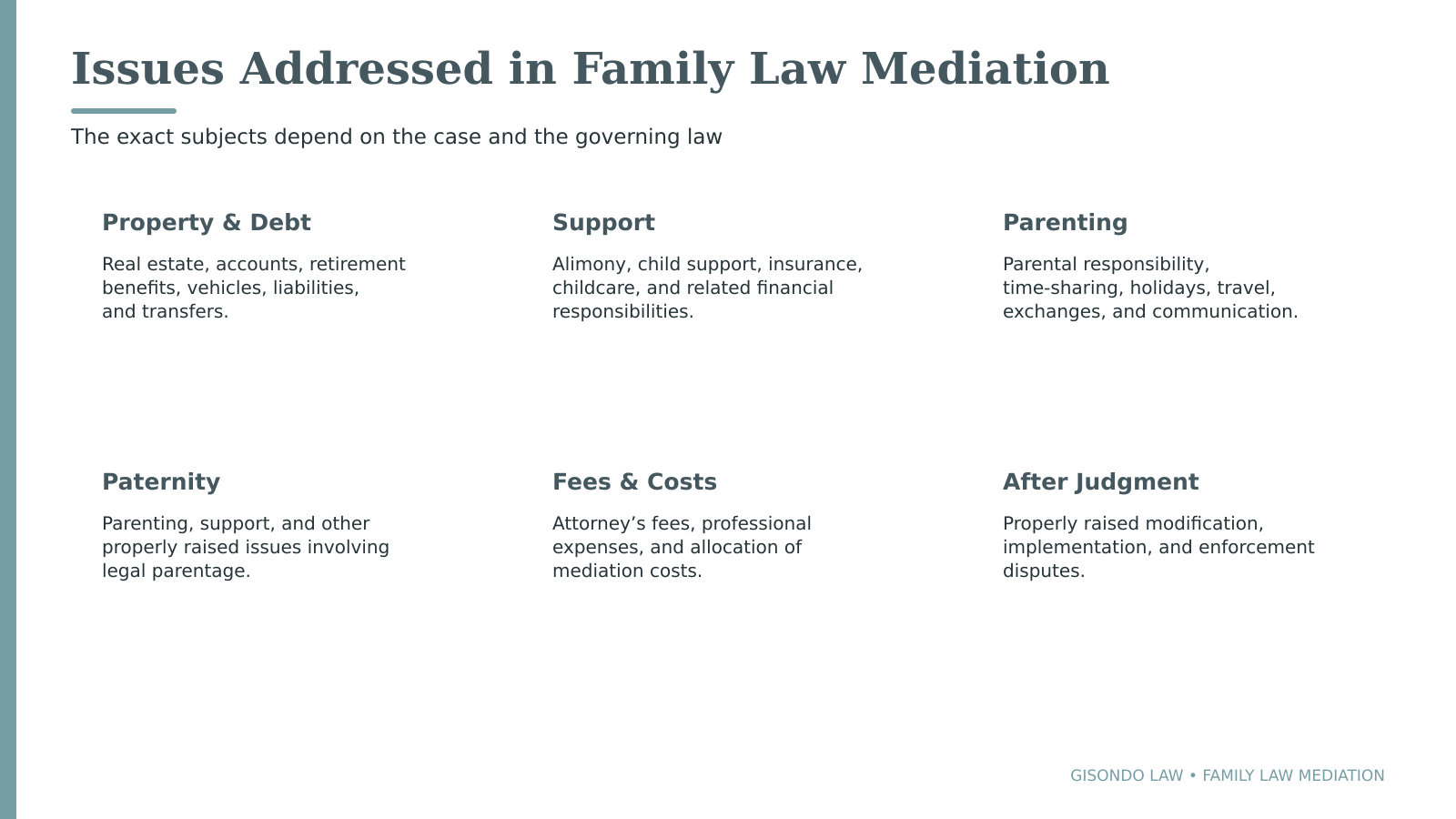
Depending on the case, mediation may address one or more of the following subjects:
Each subject has its own governing law and may require financial calculations, findings, or court approval. Mediation allows negotiation within that legal framework; it does not eliminate it.
In voluntary mediation, the parties and their attorneys may agree on a mediator. In a court-connected matter, the applicable order, rules, and local procedures govern selection or appointment. Relevant considerations may include certification, family-law knowledge, availability, fee structure, communication style, experience with disputed issues, and the ability to manage difficult dynamics impartially.
Learn more about Grant Gisondo’s approach on the firm’s Divorce & Family Law Mediation page.
Mediation may occur in person or remotely. Some sessions begin jointly, while others use separate rooms or virtual breakout rooms from the outset. The mediator may conduct private caucuses, meaning confidential discussions with one side at a time. The format should reflect the issues, the participants’ needs, any court order, and appropriate safety considerations.
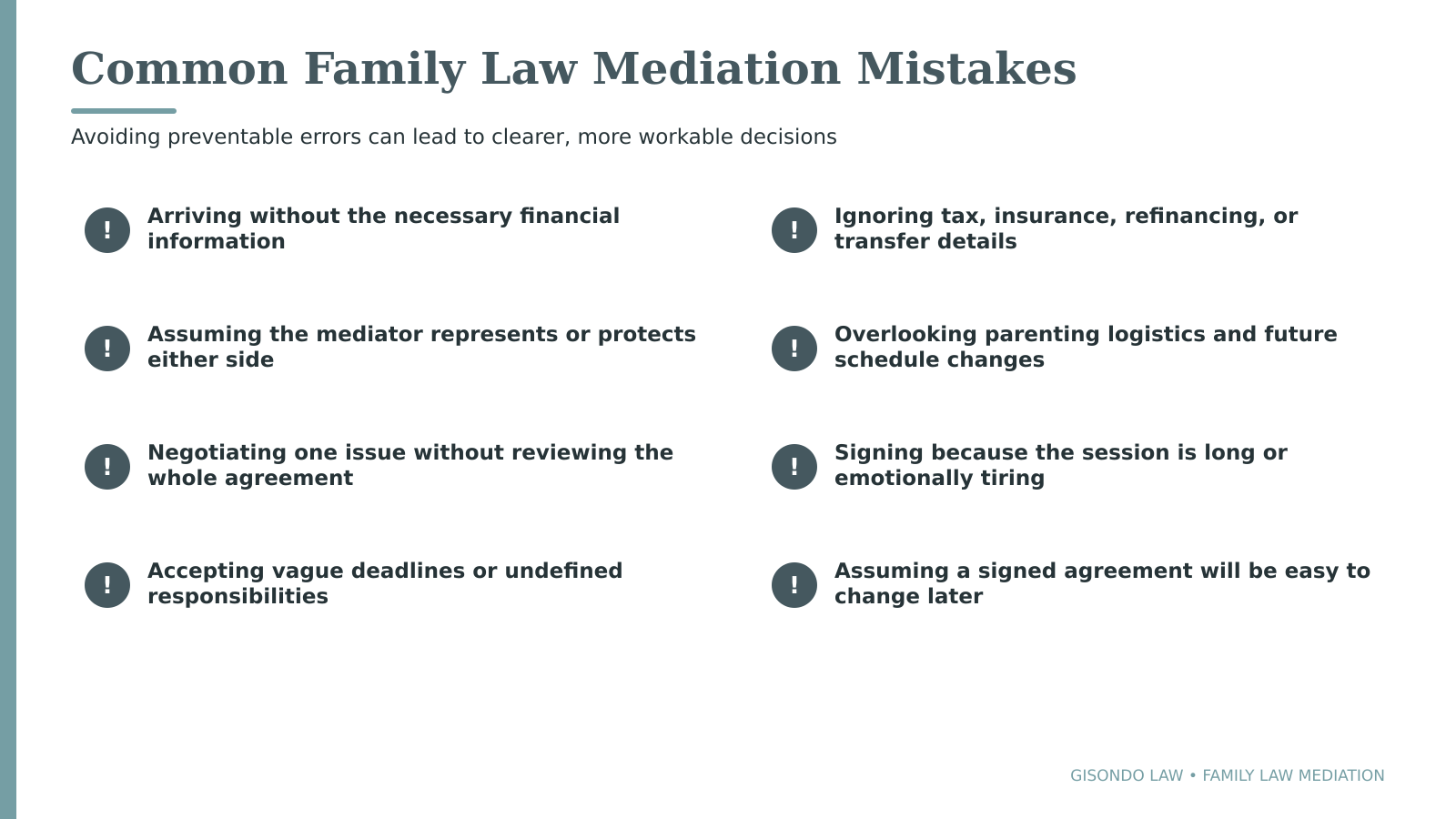
Meaningful negotiation depends on knowing what must be resolved and having sufficient reliable information. Before mediation, the parties may exchange financial affidavits, supporting documents, discovery, proposed parenting schedules, valuations, calculations, or written settlement proposals. Missing information can prevent informed agreement or require a limited agreement that preserves unresolved issues.
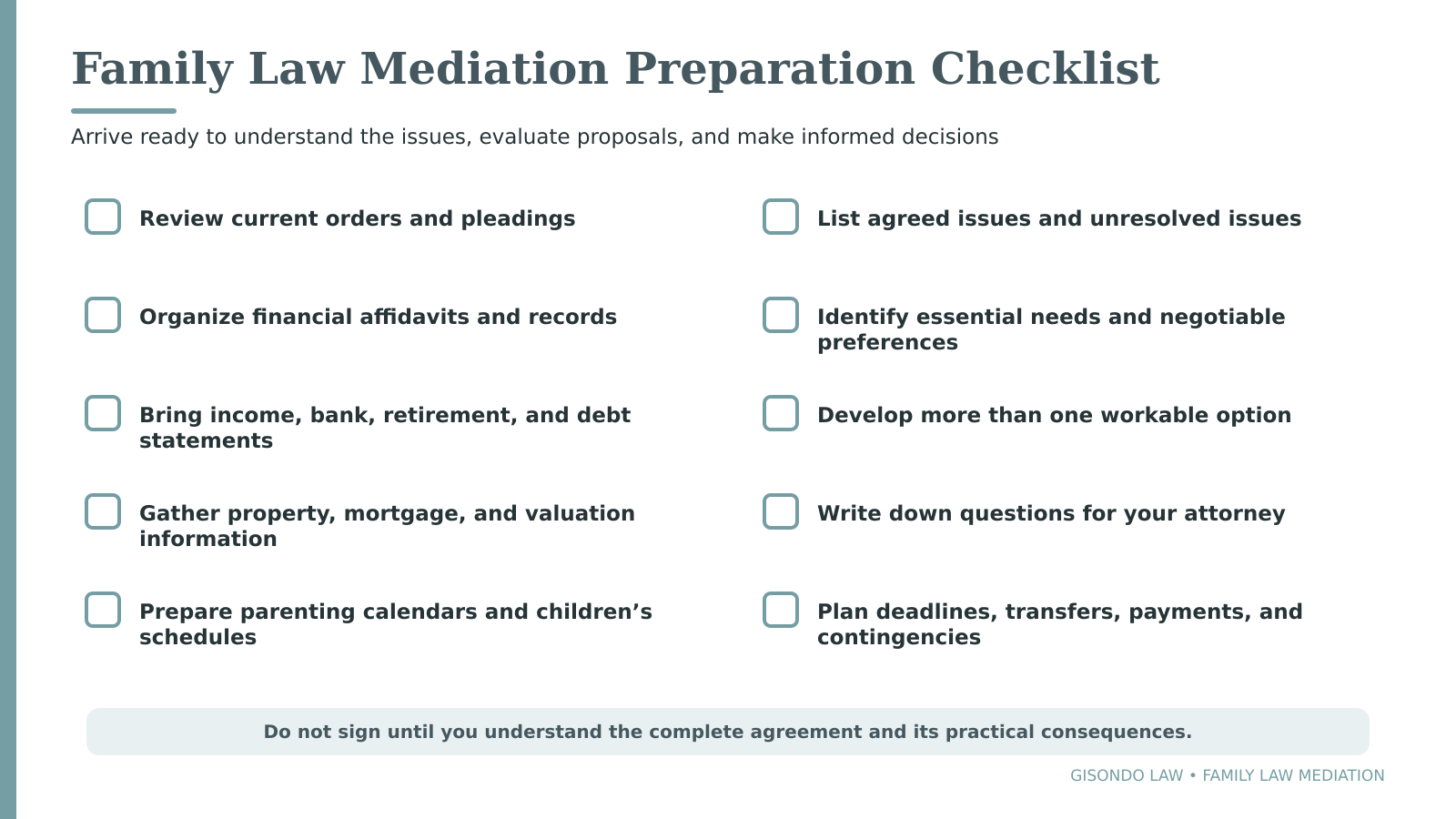
Preparation should combine documents, legal analysis, practical priorities, and implementation planning. The goal is not to predict every conversation. It is to arrive able to evaluate options instead of reacting to important proposals for the first time.
The necessary documents vary, but may include:
A useful preparation exercise is to classify issues as essential protections, high priorities, negotiable preferences, and matters requiring more information. That does not mean revealing a private negotiating range prematurely. It helps the client and attorney evaluate tradeoffs while keeping the entire proposed settlement in view.
Mediation can stall when either side treats a single proposal as the only acceptable answer. Alternative structures may address the same goal. For example, property, payment timing, security, tax effects, and parenting logistics may be structured differently. Any alternative must still be lawful, understandable, financially realistic, and sufficiently specific to implement.
An agreement should answer practical questions: Who must do what? By what date? How will money or documents be transferred? What happens if refinancing is unavailable? Who claims permitted tax benefits? Where will parenting exchanges occur? How will schedule changes be requested? What proof of compliance must be supplied? Vague promises can become future disputes.
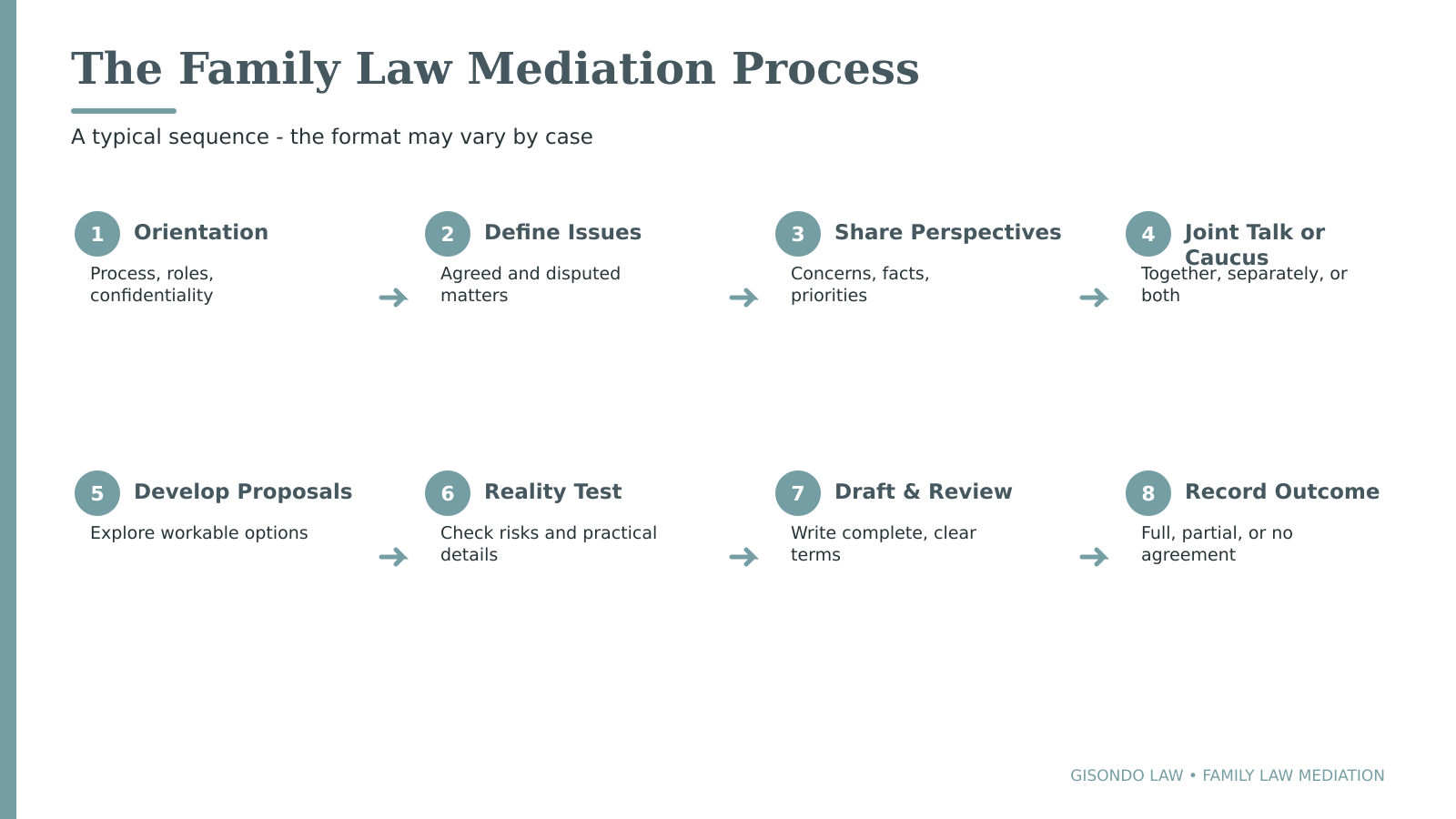
No two sessions are identical, but a family-law mediation commonly includes these stages:
A mediation may take a few hours, a full day, multiple sessions, or another amount of time appropriate to the case. Complexity, available information, emotional dynamics, the number of disputed issues, and the progress of negotiations all matter. No responsible guide can promise a universal timeline.
Florida’s Mediation Confidentiality and Privilege Act generally provides that mediation communications are confidential. A mediation party also generally has a privilege to refuse to testify—and to prevent another person from testifying in a later proceeding—about mediation communications.
This protection matters because candid settlement discussions are more likely when participants understand that offers and statements ordinarily will not be presented to the judge as proof of the underlying case. Confidentiality, however, is not absolute.
Section 44.405, Florida Statutes, identifies exceptions. Among other things, confidentiality or privilege may not attach to a signed written agreement reached during mediation unless the parties agree otherwise; communications for which all parties waive protection; communications used to plan or conceal crime or threaten violence; mandatory reports under specified Florida laws; and communications offered for limited purposes involving professional malpractice, professional misconduct, or legally recognized grounds to void or reform a mediated settlement agreement.
Information that is otherwise discoverable or admissible does not become protected merely because it was used in mediation. Parties should therefore distinguish confidential mediation communications from underlying bank statements, records, photographs, messages, or other evidence that exists independently of mediation.
Florida mediation may occur with or without attorneys depending on the circumstances and any court order. The more useful question is whether a person can make informed, protected decisions without individualized legal advice. The mediator cannot fill that role because the mediator must remain neutral.
An attorney can explain governing law, identify missing information, evaluate the strengths and risks of the case, calculate or review financial positions, help formulate proposals, and distinguish between a sensible compromise and a term that creates an avoidable problem.
An attorney can provide confidential advice as proposals change, test the wording of settlement terms, identify unaddressed issues, and advocate for the client. Legal advice can be especially important when the agreement involves real estate, retirement accounts, business interests, support, tax-sensitive provisions, or complex parenting arrangements.
A participant should understand every material term before signing. Waiting until after execution to obtain advice may be too late to avoid a binding obligation. If you are uncertain, ask whether you can have an attorney review the agreement before committing.
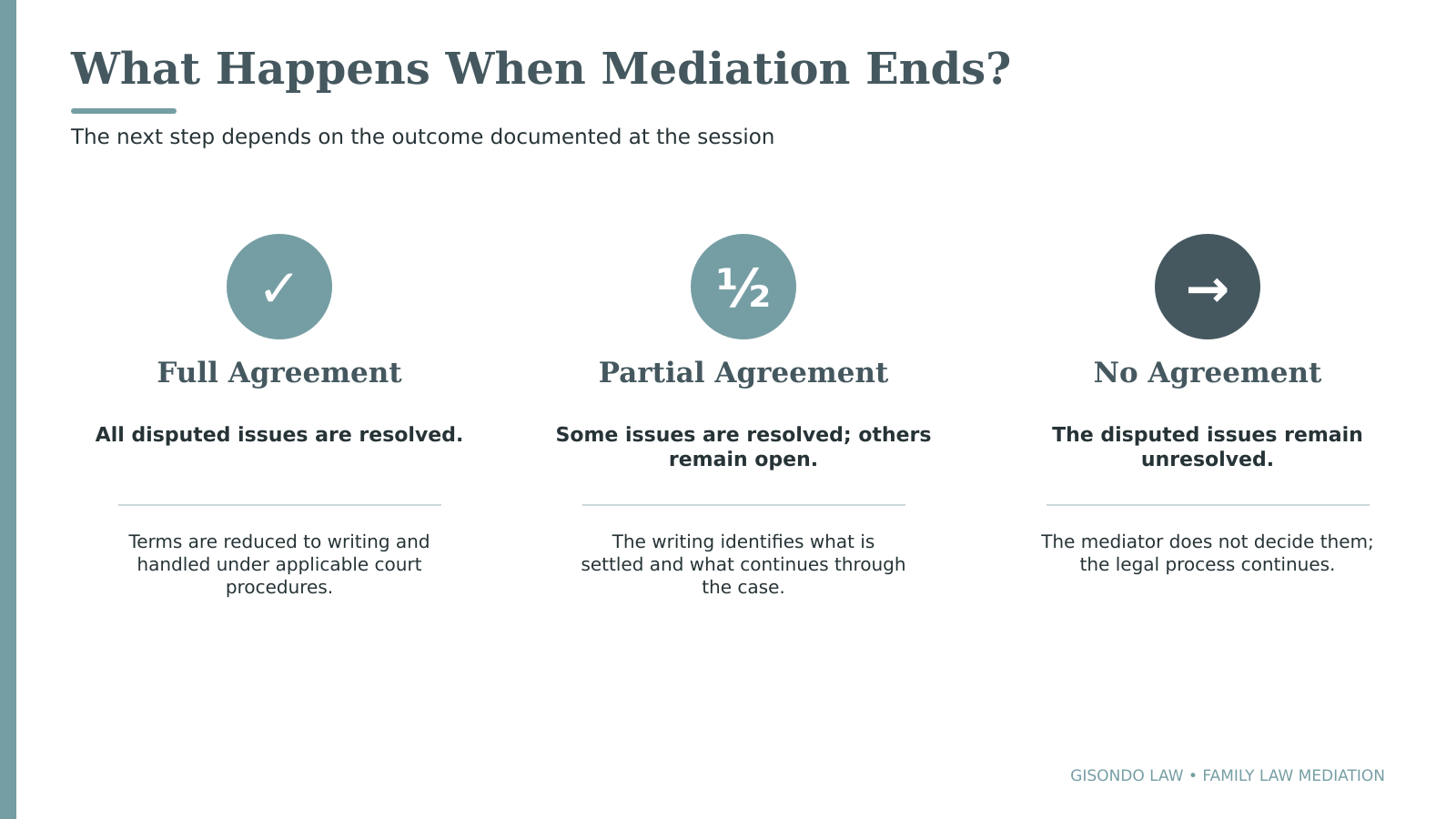
If the parties resolve all disputed issues, they document the terms in a written agreement. The agreement may then be submitted to the court when required and may become part of a final judgment or order. Court review may still be necessary, particularly for provisions involving children and other matters the law places under judicial oversight.
The parties may settle some issues and leave others unresolved. A carefully drafted partial agreement should identify exactly what is resolved, what remains open, and whether any related issue is intentionally reserved. The unresolved matters may proceed through additional negotiation, discovery, motion practice, or trial.
If no settlement is reached, the mediator does not decide the case. The parties retain access to the court, and the disputed matters continue according to the case schedule and applicable orders. The court ordinarily learns the mediation outcome—not the substance of protected negotiations.
A settlement concept is not enough. The final language must clearly state the parties’ obligations, address implementation, avoid internal contradictions, and reflect the complete bargain. Terms involving future payments, transfers, parenting decisions, contingencies, deadlines, or enforcement require particular care.
Mediation is not automatically appropriate in the same format for every family. Domestic violence, coercive control, threats, intimidation, stalking, severe power imbalances, hidden assets, substance misuse, cognitive impairment, or emergency child-safety concerns may affect whether and how meaningful participation can occur.
Possible measures may include separate rooms, virtual participation, attorney attendance, support persons when permitted, staggered arrival and departure, limits on direct communication, additional information exchange, shorter sessions, or termination of the mediation. The appropriate response depends on the circumstances, the mediator’s ethical duties, applicable law, and any court orders.
Anyone facing an immediate safety risk should prioritize safety and appropriate legal or emergency assistance. Mediation should never be described as requiring a person to bargain away safety or submit to intimidation.
Grant J. Gisondo, Esq., is Board Certified in Marital and Family Law by The Florida Bar and is a Florida Supreme Court certified civil and family law mediator. His combined experience allows him to understand mediation from two distinct perspectives: as a neutral mediator, facilitating resolution, and as a family-law attorney advising and advocating for an individual client.
The Law Offices of Grant J. Gisondo, P.A. assists clients with divorce and family-law matters in Palm Beach and Martin counties, with offices in Palm Beach Gardens, West Palm Beach, and Stuart.
Learn more about Grant J. Gisondo’s qualifications and experience or why Board Certification in Marital and Family Law matters.
Whether you need a neutral mediator for a family-law dispute or an attorney to prepare for and represent you during mediation, understanding the role Grant would serve is the first step. The Law Offices of Grant J. Gisondo, P.A. can help you evaluate the process, prepare thoughtfully, and approach important decisions with greater clarity.
Call 561.530.4568 to schedule a free, initial, in-office consultation with The Law Offices of Grant J. Gisondo, P.A.
This guide provides general educational information about Florida family law mediation. It is not legal advice, does not address every exception or local procedure, and does not create an attorney-client or mediator-participant relationship. Laws, court rules, administrative orders, and individual circumstances may change the analysis. Consult a qualified Florida attorney regarding your specific situation. Do not send confidential information until an attorney-client relationship has been established and confirmed.