Law Offices of Grant J. Gisondo, P.A. Logo

(561) 530-4568

Call For Free Consultation

9:00-5:00 M-F

Saturday Appointments Available

Palm Beach Gardens (Main Office)

500 Village square crossing #103
Palm Beach Gardens, FL 33410
Phone: 561-530-4568

West Palm Beach

777 South Flagler Drive, Suite 800 - West Tower, West Palm Beach, Florida 33401
Phone: 561-530-4568

Stuart

1 SE Ocean Blvd., Stuart, FL 34994
Phone: 561-530-4568

9:00-5:00 M-F

Saturday Appointments Available

(561) 530-4568

Call For Free Consultation

Searcharea Opener Search
Sidearea Opener Menu
500 Village square crossing, #103 Palm Beach Gardens, FL 33410
Back to top
Grant J. Gisondo, P.A. – Family Law Attorney
Clear guidance on support calculations, modifications, unpaid support, and enforcement

The Attorney’s Guide to Child Support and Arrears in Florida

Last reviewed: August 2026

Child support questions often arise at stressful turning points: a separation, a paternity case, a divorce, a job loss, a major change in a child’s needs, or the discovery that months of support have not been paid. This guide is for Florida parents who need a clear starting point—whether they expect to pay support, receive it, request a change, collect past-due support, or respond to enforcement action.

Florida uses statutory child support guidelines, but the final obligation depends on accurate financial information, the parenting schedule, child-related expenses, and the wording of the court order. Arrears add another layer because amounts that have already become due are not treated the same way as future monthly payments. The goal here is to explain those distinctions in practical language while showing when individualized legal advice may be important.

Parent and Child Florida

Important: This guide provides general educational information. It does not calculate support for a particular family and does not replace advice from a Florida family-law attorney who has reviewed the order, payment history, financial records, and facts of the case.

Florida Child Support at a Glance

The short answer:
Florida generally calculates child support under the statutory guidelines using both parents’ net incomes, the number of children, qualifying child-related expenses, and the parenting schedule. An order stays enforceable until it is changed, terminated, or vacated through the proper legal process.

Question General Florida Rule
What is child support? A court-ordered contribution toward a child's financial needs. Both parents have a duty to support their minor or legally dependent children.
Can parents waive it? Parents may resolve many financial issues by agreement, but they cannot simply bargain away a child's right to support. A court must determine whether the arrangement is lawful and appropriate.
Does equal time-sharing eliminate support? No. The parenting schedule affects the calculation, but a substantial or equal number of overnights does not automatically produce a zero obligation.
What are arrears? Amounts that became due under an existing support order but were not paid in full and on time.
Can support change? Yes, when the legal requirements for modification are met. Until a new order is entered, the existing amount remains owed.
Do arrears vanish at age 18? No. The end of current support does not erase unpaid amounts that accrued earlier.

Understanding Child Support in Florida

Florida law begins with a basic principle: each parent has a fundamental obligation to support a minor or legally dependent child. Child support may be addressed in a dissolution of marriage, paternity case, support proceeding, or post-judgment matter. The obligation is for the child’s benefit; it is not a reward to one parent or a punishment imposed on the other.

The paying and receiving parents

Orders often refer to the parent who owes support as the obligor and the parent to whom support is paid as the obligee. Those labels describe the payment direction; they do not determine who is the “better” parent. Both parents contribute to the costs of income, direct care, housing, food, transportation, insurance, and other expenses. The guideline calculation allocates the financial responsibility between them.

Support and time-sharing are related—but separate

The number of overnights can materially affect the support calculation. Even so, child support and time-sharing are separate duties. A parent generally should not stop paying because the other parent interfered with time-sharing, and a parent generally should not withhold time-sharing because support is unpaid. Each problem requires the appropriate legal remedy.

Child support is different from alimony

Child support is intended for the child’s needs. Alimony, when awarded, concerns support between former spouses. The two may interact in financial calculations, but they serve different purposes and are subject to different legal standards. Detailed alimony questions belong in a separate Attorney’s Guide.

How Florida Child Support Is Calculated

Florida Statutes §§ 61.29 and 61.30 establish the principles and guidelines for calculating child support. The guideline amount is presumptive, meaning it typically serves as the starting amount the court should order. The calculation is more than a percentage of one parent’s paycheck.

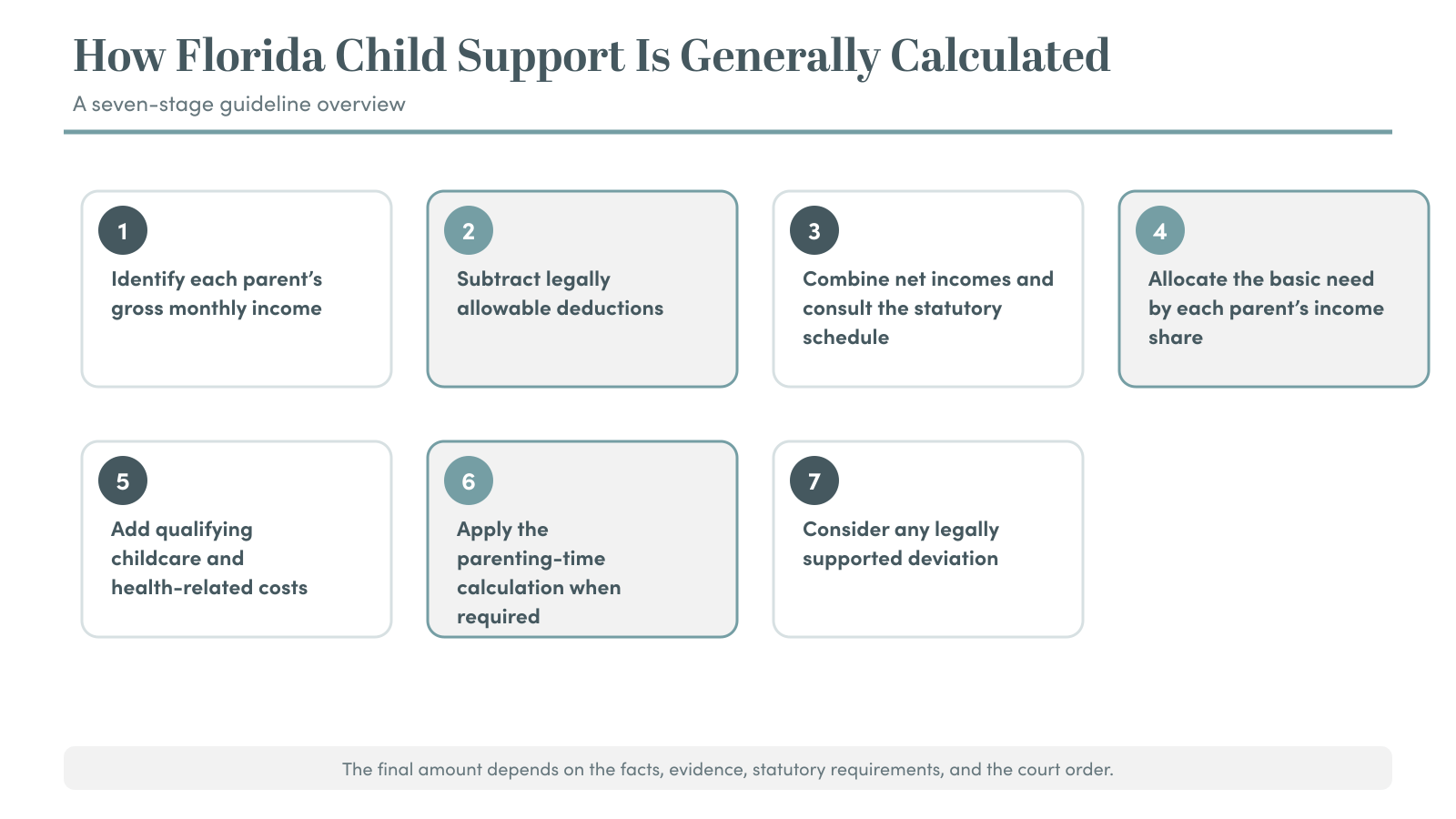
Child Support Calculation Flowchart

The guideline process

  1. Determine each parent’s gross monthly income from all legally recognized sources.
  2. Subtract allowable deductions to reach each parent’s net monthly income.
  3. Combine the parents’ net incomes and use the statutory schedule for the number of children.
  4. Allocate the basic support need according to each parent’s percentage of the combined net income.
  5. Add or allocate qualifying childcare, health-insurance, and uncovered medical expenses.
  6. Apply the parenting-time calculation when the statutory requirements are met.
  7. Consider whether a legally supported deviation from the guideline amount is appropriate.

What may count as income?

Florida’s definition is broad. Depending on the facts, gross income may include wages, salary, bonuses, commissions, overtime, business or self-employment income, disability benefits, workers’ compensation, unemployment compensation, pension or retirement payments, interest and dividends, rental income, royalties, reimbursed expenses that reduce living costs, and other recurring sources identified by statute. Certain public-assistance benefits are excluded.

Gross receipts are not necessarily the same as usable business income. For a self-employed parent, ordinary and necessary business expenses may be considered, while personal expenses paid by a business or deductions allowed for tax purposes may require closer review. Financial affidavits, tax returns, bank statements, profit-and-loss statements, payroll records, and business records can therefore matter greatly.

Allowable deductions and net income

After gross income is identified, the guidelines allow specified deductions, which may include federal, state, and local income-tax deductions; mandatory retirement payments; mandatory union dues; health-insurance payments other than coverage for the children at issue; court-ordered support actually paid for other children; and certain alimony payments. The precise treatment depends on the statute and evidence. A tax return alone may not answer every question.

Time-sharing and overnights

Florida’s guideline formula contains an adjustment when each parent has the child for a substantial number of overnights. The calculation recognizes that both households incur expenses during parenting time. It does not mean that equal time-sharing automatically cancels support. A difference in income, insurance costs, childcare, or other adjustments may still result in a payment from one parent to the other.

Hidden, underreported, or intentionally reduced income

When a parent is voluntarily unemployed or underemployed, a court may impute income if the statutory requirements are met. The inquiry may examine recent work history, qualifications, education, prevailing earnings in the community, job-search efforts, and the reason for the change in employment. Courts distinguish between a genuine involuntary setback and an intentional reduction designed to avoid support.

Complex compensation can also require additional discovery. Cash income, business-paid personal expenses, retained earnings, irregular bonuses, cryptocurrency, online platform income, or transfers among related accounts may not be apparent from a single pay stub. A party alleging hidden income should be prepared to identify reliable records rather than rely on suspicion alone.

Deviation from the guideline amount

A court may order an amount that differs from the guideline when the law permits and the evidence supports it. Florida law identifies potential considerations, including extraordinary medical, psychological, educational, or dental expenses; special needs; seasonal variations in income or expenses; age-related needs; travel costs for parenting time; and other statutory factors. A deviation must be explained as required by law; it is not simply an informal compromise untethered to the child’s interests.

Practical point: Online calculators can help parents understand the structure of the formula, but they are only as accurate as the figures entered. They may not properly address disputed income, self-employment, imputation, deviations, retroactive periods, or unusual orders.


Expenses Beyond the Basic Monthly Payment

A support order may address more than the monthly transfer from one parent to the other. Health insurance, uncovered medical expenses, employment-related childcare, and other child-specific costs can affect the guideline calculation or be separately allocated. The order’s exact wording is critical.

  • Health-insurance premiums attributable to the child.
  • Uncovered medical, dental, vision, prescription, therapy, or related expenses.
  • Childcare needed because a parent is working, seeking work, or pursuing qualifying education.
  • Extraordinary educational or special-needs expenses when legally supported.
  • Travel costs related to time-sharing when addressed by agreement or court order.
  • Extracurricular, camp, tutoring, device, vehicle, or college expenses only when the order, agreement, or applicable law makes them enforceable.

Parents often disagree because one assumes every expense should be divided while the other reads the order more narrowly. Before demanding reimbursement or refusing a request, review whether the expense is covered, whether advance consent is required, what percentage applies, what documentation must be exchanged, and when reimbursement is due.

Retroactive Child Support

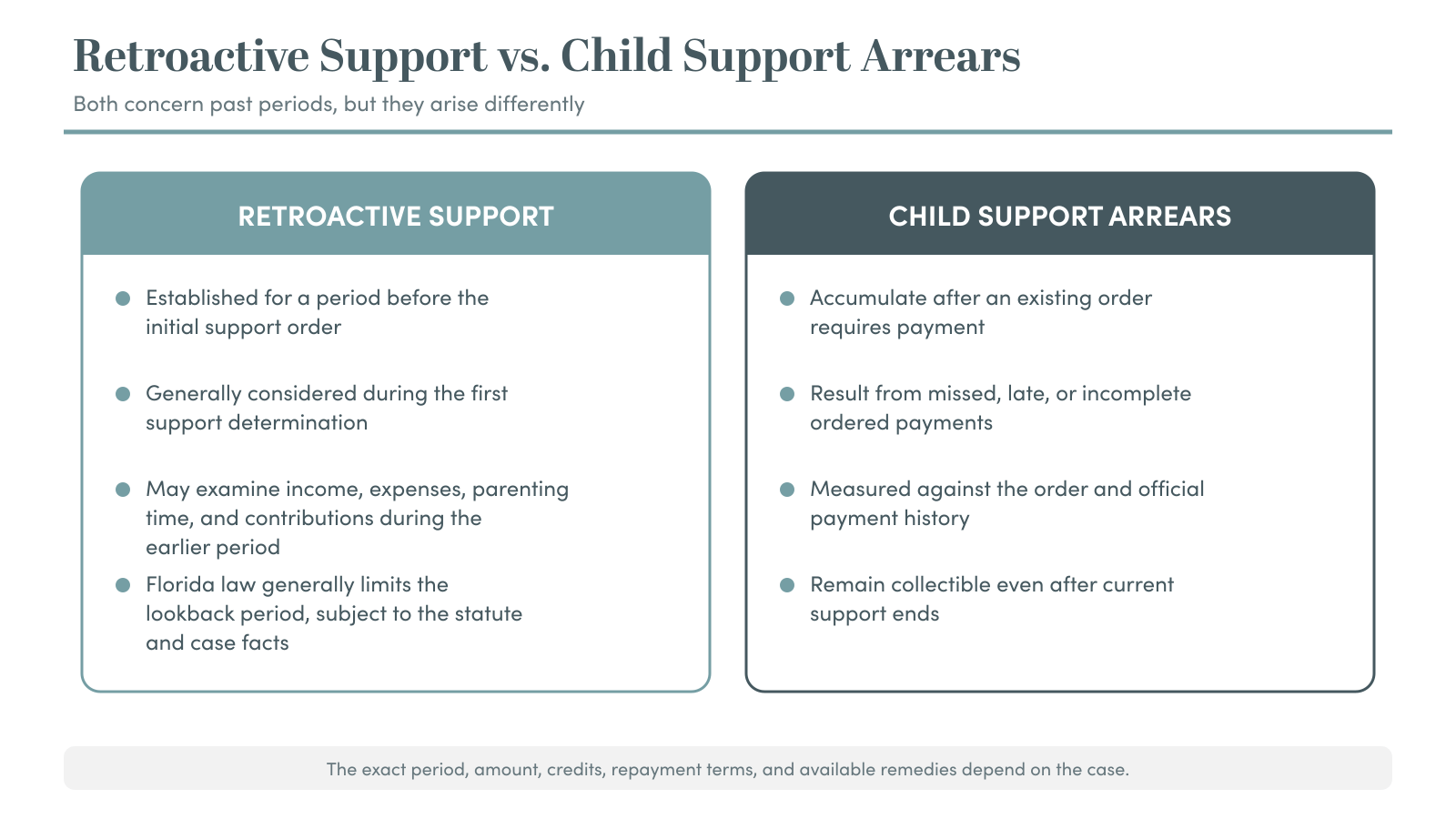
Retroactive Support vs Child Support Arrears

Retroactive child support is support established for a period before the initial support order. It is different from arrears that accumulated after an existing order required payment. In an initial Florida determination, the court may award retroactive support for the period during which the parents did not live with the child, generally not exceeding 24 months before the petition was filed, subject to the statute and case-specific facts.

The court evaluates the parents’ circumstances during the retroactive period. Income, available deductions, childcare, health insurance, the parenting schedule, and actual payments or contributions may have changed month by month. The court may consider payments made and may establish a repayment schedule for the retroactive obligation.

Do not confuse these terms:
Retroactive support creates an initial obligation for an earlier period. Arrears are unpaid installments under an order that was already in force. Both can produce a past-due balance, but they arise differently and may require different proof.

What Are Child Support Arrears?

Child support arrears arise when a required payment is missed, is late, or is less than the ordered amount. The balance may include unpaid monthly support, ordered reimbursement obligations, retroactive support installments, or other amounts specifically included in the order. Interest may apply under Florida law, depending on how the obligation has been established and calculated. The exact ledger should be reviewed rather than estimated.

How arrears accumulate

Support installments ordinarily become due according to the order. A parent cannot safely reduce the amount because a child spent more time in that parent’s home, because the other parent agreed verbally, or because income declined. Florida’s Child Support Program states that until an order is changed, terminated, or vacated, the ordered amount remains owed and enforceable.

Direct and informal payments

Cash, peer-to-peer transfers, groceries, clothing, school purchases, or payments made directly to a child can create disputes. A court may not treat a gift or voluntary purchase as a substitute for ordered support. Direct payments may also be difficult to credit if the order requires payment through the State Disbursement Unit or depository. Keep receipts, bank records, transfer descriptions, and written acknowledgment of the purpose of every payment.

After the child becomes an adult

The end of ongoing child support does not erase arrears. Past-due amounts remain subject to collection and enforcement. A final regular payment may therefore end only the current monthly obligation, while an additional arrears payment continues until the balance is satisfied.

What to Do When Child Support Is Not Being Paid

Begin with the order and an accurate payment history. Enforcement is strongest when the amount due, the amount paid, and the requested remedy are clearly shown.

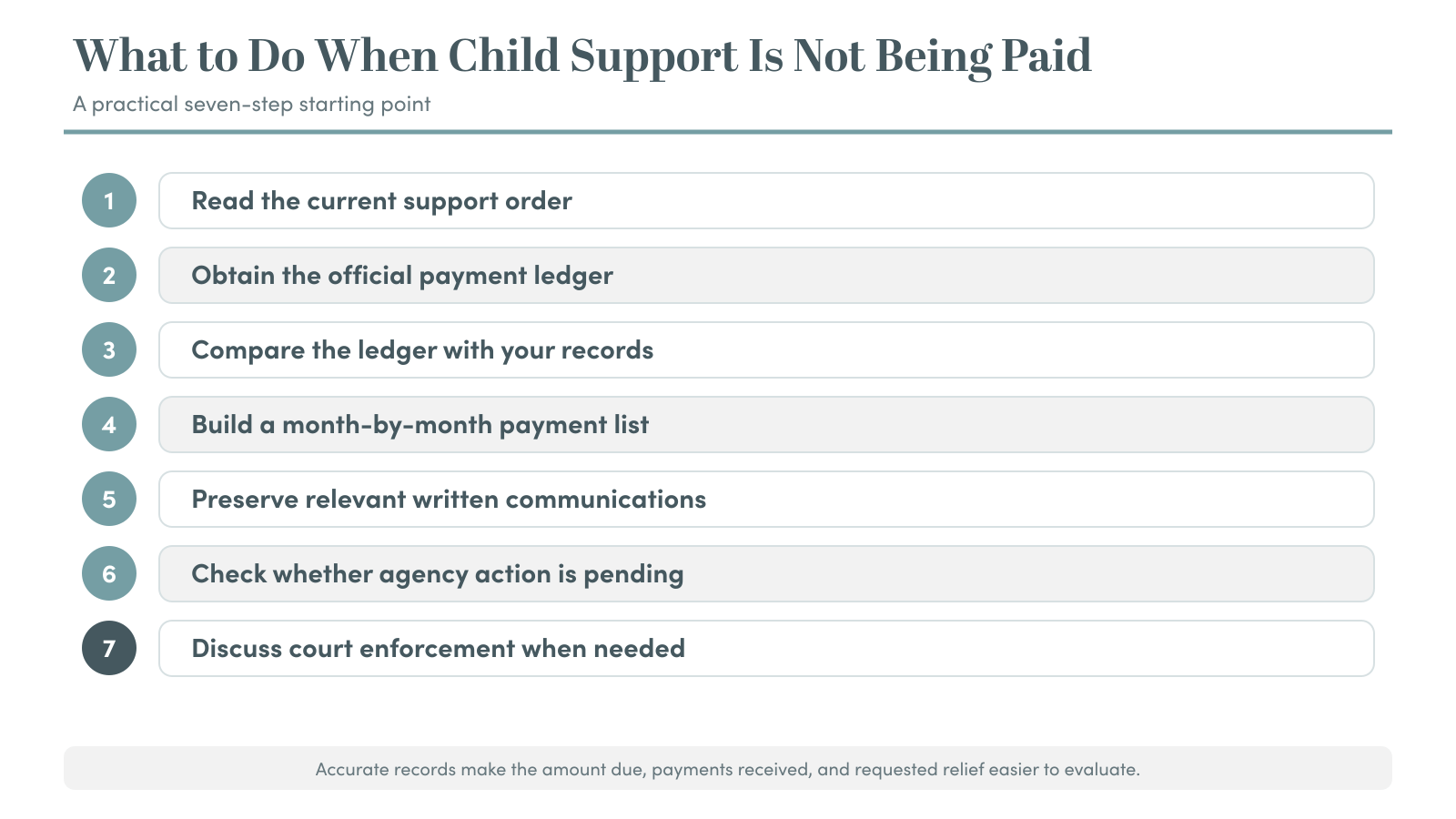
What to Do When Child Support Is Not Being Paid
  1. Read the current order, including payment dates, payment channel, health-care provisions, reimbursement terms, and any arrears installment.
  2. Obtain the official payment ledger from the clerk, depository, State Disbursement Unit, or Child Support Program, as applicable.
  3. Reconcile the official record with bank statements, receipts, direct payments, and prior credits.
  4. Create a month-by-month list of the ordered amount, payment received, shortfall, and supporting record.
  5. Preserve written communications about missed payments, employment, assets, or proposed repayment.
  6. Determine whether the Florida Child Support Program is involved and what administrative action is already pending.
  7. Discuss court enforcement with a family-law attorney when the balance is disputed, contempt is sought, or the matter involves complex income or assets.

Documents to gather

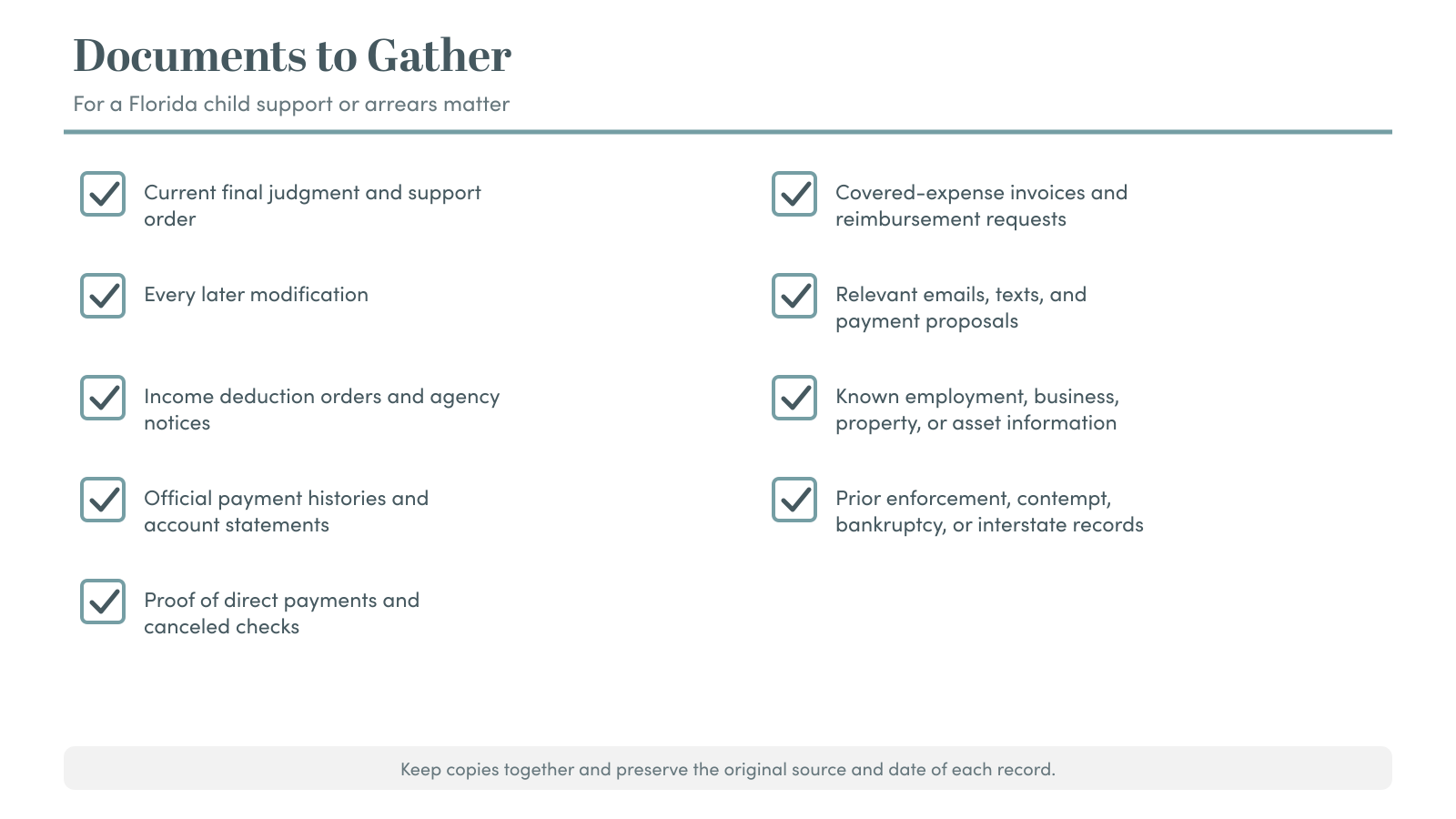
Documents to Gather Checklist
  • The most recent final judgment, support order, and every later modification.
  • Income deduction orders and notices from the Child Support Program.
  • Official payment histories and account statements.
  • Proof of direct payments, including canceled checks and electronic-transfer records.
  • Invoices and reimbursement requests for expenses covered by the order.
  • Relevant emails, texts, and written payment proposals.
  • Known employment, business, banking, property, or asset information.
  • Documents from any prior enforcement, contempt, bankruptcy, or interstate proceeding.

Enforcement of Support and Arrears

Florida uses both judicial and administrative tools to collect support. The available action depends on the type of case, the amount and age of the balance, the parent’s payment and employment history, available assets, notice requirements, and whether the Florida Child Support Program is providing services.

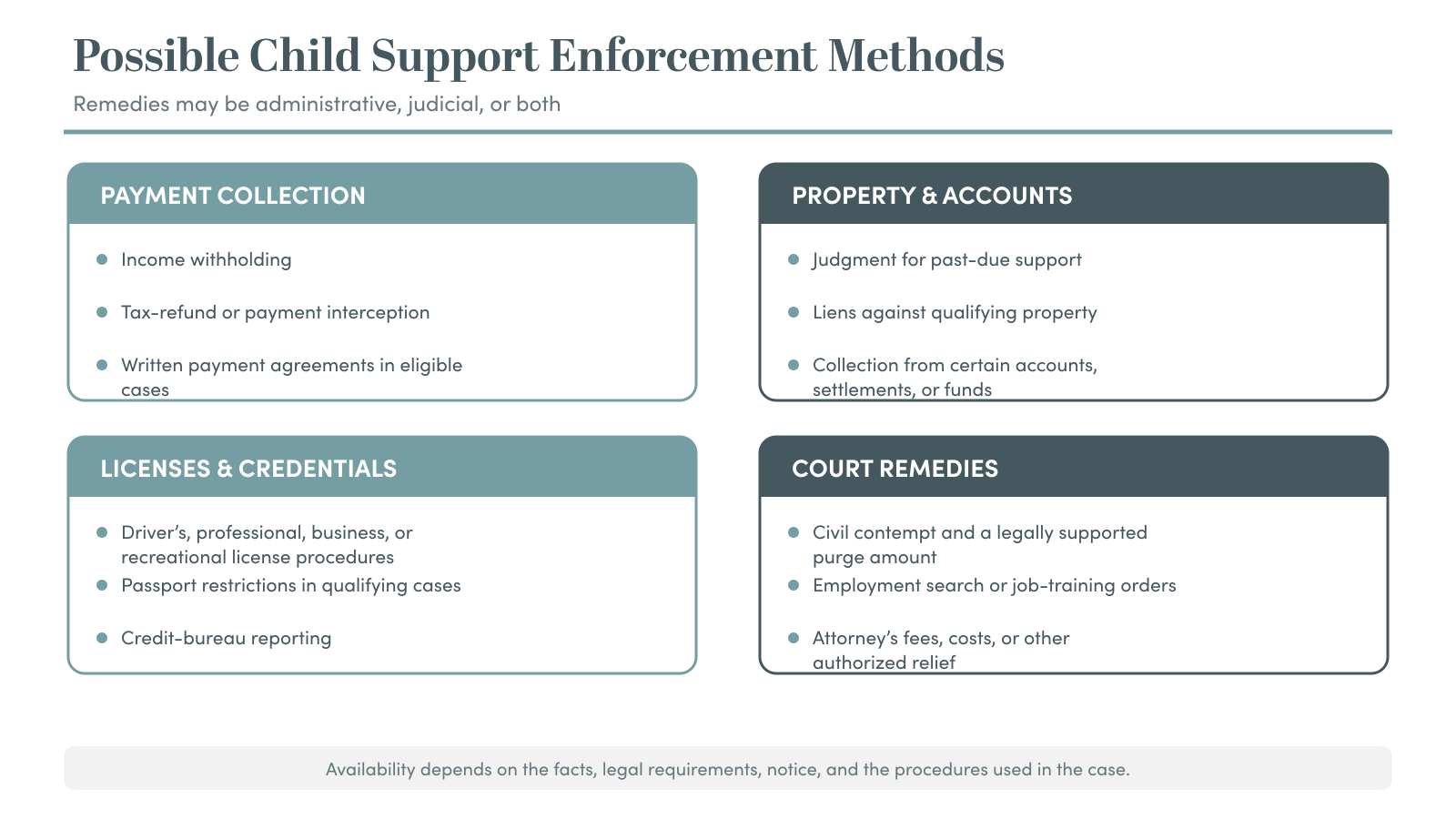
Possible Child Support Enforcement Methods

Possible enforcement measures

  • Income withholding from wages or other income.
  • Entry or confirmation of a judgment for past-due support.
  • Interception of qualifying federal or state tax refunds or other payments.
  • Liens or collection against certain property, settlements, or financial accounts.
  • Credit-bureau reporting.
  • Suspension or denial procedures affecting driver’s, recreational, professional, or business licenses when statutory conditions are met.
  • Passport restrictions in qualifying cases.
  • Court orders requiring employment searches or job training.
  • Civil contempt proceedings and a purge amount when the legal requirements are satisfied.
  • Attorney’s fees, costs, or other relief when authorized.

These remedies are not interchangeable, and many require specific notices and opportunities to contest the action. A person who receives an intent-to-suspend, levy, lien, hearing notice, or motion for contempt should read the response deadline immediately. Missing a deadline can narrow the available options.

Payment agreements

The Florida Child Support Program may offer a written agreement allowing past-due support to be repaid over time in an eligible case. The arrears remain owed; the agreement changes the repayment path, not the existence of the debt. A private agreement between parents may not stop an administrative or court enforcement process unless it is handled in a legally effective manner.

Civil Contempt and the Ability to Pay

Civil contempt is a serious enforcement remedy. The central question is not merely whether support went unpaid. The court must address willfulness and the parent’s present ability to comply with the purge condition. Florida’s Child Support Program explains that incarceration for willful nonpayment requires a specific finding that the parent has the present ability to pay the specified purge amount.

At a hearing, evidence may concern income, employment, bank accounts, property, recent transfers, expenses, borrowing ability, job-search efforts, health limitations, and the reason payments stopped. A genuine inability to pay is different from hiding assets, refusing available work, or voluntarily reducing earnings. Both parents benefit from organized, current financial proof.

What to Do If You Owe Child Support Arrears

Ignoring arrears generally makes the situation harder. A prompt, documented response can identify accounting errors, preserve defenses, and create a realistic path toward compliance.

  • Do not ignore a summons, motion, notice of intent, hearing date, or response deadline.
  • Get the complete order history and official ledger; do not rely only on another person’s total.
  • Identify any missing payments or credits in the record and gather supporting documentation.
  • Continue making current support and arrears payments as ordered when possible.
  • Use the required payment channel and label payments clearly.
  • Do not assume gifts or purchases for the child replace support.
  • Document involuntary job loss, medical limitations, applications, interviews, and efforts to obtain income.
  • Ask promptly whether modification of future support is appropriate.
  • Explore a lawful payment agreement or settlement of disputed accounting issues.
  • Speak with counsel before a contempt hearing or significant administrative enforcement deadline.

A parent should not promise an amount they cannot maintain. A workable plan should address current support, the arrears installment, and reliable payment dates. A modification may reduce or increase future obligations if the legal standard is met, but it generally does not erase installments that accrued before the legally effective date of the modification.

Modifying a Child Support Order

Florida courts retain jurisdiction to modify child support when the statutory requirements are met. Common grounds may include a substantial change in a parent’s income, a material change in the parenting schedule, changed childcare or insurance costs, or a meaningful change in the child’s needs. The change must satisfy the applicable legal standard; a small or temporary fluctuation may not be enough.

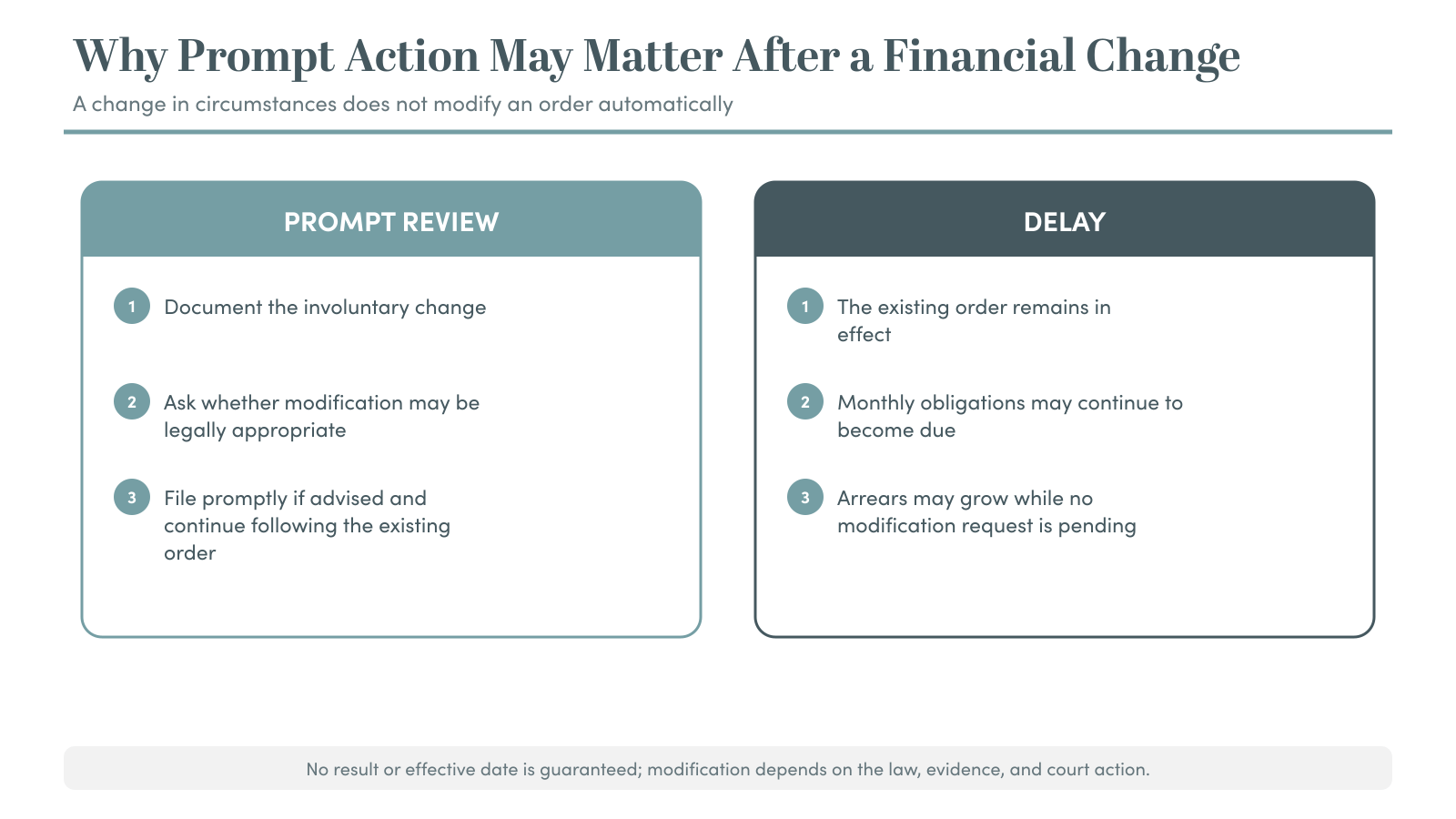
Act promptly

A job loss, disability, reduction in hours, or a change in parenting does not automatically alter the order. A court may generally make a modification effective back to the filing date of the modification action, as equity requires, not simply to the date the problem began. Delay can therefore allow arrears to grow under the existing amount.

Modification Timing Timeline

Modification is not arrears forgiveness

A modification normally addresses the amount due going forward and, when authorized, from the legally effective retroactive date. It does not ordinarily cancel vested installments that came due before then. A parent who needs both a future adjustment and a plan for existing arrears should treat those as related but distinct issues.

Evidence commonly needed

  • Current and prior financial affidavits.
  • Tax returns, pay statements, and proof of benefits.
  • Business financial records for self-employed parents.
  • Proof of involuntary employment change and job-search efforts.
  • Updated parenting calendars and overnight records.
  • New childcare, insurance, medical, educational, or special-needs costs.
  • The existing order and complete payment history.

When Child Support Ends

In most cases in Florida, current support ends when the child reaches 18. Florida law also addresses a dependent child between 18 and 19 who remains in high school, is performing in good faith, and has a reasonable expectation of graduating before age 19. Other rules may apply to a dependent adult child, and parents may have enforceable agreements that extend support.

Support orders entered on or after October 1, 2010, generally must state the termination date and, when more than one child is covered, provide a step-down schedule showing the amount owed as each child ceases to qualify. Older or unclear orders may require review before a parent changes the payment. Emancipation, marriage, military service, death, or other circumstances may also affect the obligation under Florida law.

Remember: Termination of current support and satisfaction of arrears are separate. If past-due support remains, collection can continue after the child reaches adulthood.

Child Support Across State Lines

A parent’s move does not end support. Florida and other states use the Uniform Interstate Family Support Act to establish, register, enforce, and in appropriate circumstances modify support orders across state lines. The state that issued the order may retain continuing, exclusive jurisdiction, so the location of the parents and child—and the history of the case—matters.

An out-of-state order may need to be registered before it can be enforced or modified in Florida. A parent may have limited grounds and strict deadlines to contest registration. Interstate cases can also involve different agencies, employers, payment systems, and choice-of-law rules. Obtain the complete certified order history before starting a new proceeding.

Common Child Support Mistakes to Avoid

  • Relying on a verbal agreement to reduce, pause, or redirect support.
  • Assuming equal time-sharing automatically means no payment.
  • Stopping support because time-sharing is being denied.
  • Withholding time-sharing because support is unpaid.
  • Paying cash without a receipt or clear written description.
  • Treating gifts, clothing, travel, or direct purchases as automatic credits.
  • Waiting months to seek modification after an involuntary financial change.
  • Using only tax returns to evaluate self-employment or complex compensation.
  • Ignoring reimbursement of language and documentation deadlines in the order.
  • Assuming support ends automatically without checking the order.
  • Missing a response deadline in a levy, suspension, interstate, or contempt matter.
  • Failing to keep the official ledger and personal payment records together.

When Legal Advice Is Especially Important

Many parents can obtain basic account information through the clerk or Florida Child Support Program. Legal advice becomes particularly important when the dispute requires interpretation, evidence, court advocacy, or coordination of several remedies.

  • Income is hidden, underreported, irregular, or tied to a closely held business.
  • A parent is accused of voluntary unemployment or underemployment.
  • The payment ledger is materially wrong or direct payments are disputed.
  • A large arrears balance or interest calculation is contested.
  • Contempt, incarceration, a purge amount, or a writ of bodily attachment is at issue.
  • A bank levy, lien, license action, passport restriction, or asset collection is pending.
  • A major involuntary change in income may justify prompt modification.
  • The parenting schedule changed, but the support order did not.
  • The child has significant medical, educational, or special needs.
  • The order comes from another state, or more than one state is involved.
  • An older order lacks a clear termination or step-down provision.

Frequently Asked Questions

How is child support calculated in Florida?

Do I still pay child support with equal time-sharing?

Can parents agree to waive child support?

What happens if a parent refuses to pay?

Can unpaid child support lead to jail?

Can a driver’s license be suspended?

Can child support arrears be forgiven?

Do arrears disappear when the child turns 18?

Can I stop paying if the other parent denies time-sharing?

Do gifts, clothing, or direct purchases count as support?

Can support change after I lose my job?

Can modification erase existing arrears?

How do I prove direct payments?

Can Florida enforce an out-of-state order?

Does remarriage affect child support?

When does support officially end?

Helpful Official Florida Divorce Resources

About Grant J. Gisondo

Grant J. Gisondo, Esq., is Board Certified in Marital and Family Law. Through The Law Offices of Grant J. Gisondo, P.A., he represents clients in divorce, child support, time-sharing, modification, enforcement, and other marital and family-law matters. The firm has offices in Palm Beach Gardens, West Palm Beach, and Stuart and serves clients throughout Palm Beach and Martin counties.

Learn more about Grant’s Board Certification or view the attorney profile.

Schedule a Free Consultation

Child Support Consultation

Get clear guidance about your Florida child support matter

Whether you are establishing support, trying to collect unpaid support, responding to enforcement, disputing a payment history, or dealing with a major financial change, understanding the order and your legal options is an important first step.

Speak With a Palm Beach Gardens Child Support Attorney Today

Contact The Law Offices of Grant J. Gisondo, P.A. at 561-530-4568 to schedule a free consultation with Grant J. Gisondo, Esq., Board Certified in Marital and Family Law. The firm serves clients from offices in Palm Beach Gardens, West Palm Beach, and Stuart.

Schedule a Confidential Consultation

Legal Disclaimer

This guide is provided for general educational and informational purposes only. It is not legal advice and should not be relied upon as a substitute for advice from a licensed attorney concerning a specific situation. Reading this guide, visiting the firm’s website, calling the office, or sending information does not by itself create an attorney-client relationship. Do not send confidential information unless and until an attorney-client relationship has been established. Laws, rules, procedures, forms, and agency practices may change, and outcomes depend on the particular facts, evidence, court orders, and current law.