
The Attorney’s Guide to Divorce & Dissolution of Marriage of Florida
A practical overview of the Florida divorce process—from the first filing through the final judgment.

Call For Free Consultation
Saturday Appointments Available


A practical overview of the Florida divorce process—from the first filing through the final judgment.

Divorce can feel overwhelming, especially when you are uncertain about what to expect from the legal process. This guide is for individuals considering divorce, preparing to file, or responding to a divorce petition in Florida. It provides a clear overview of the dissolution-of-marriage process, from the initial filing through the final judgment, so you can better understand the general steps involved and prepare for the decisions ahead.
Every divorce is different, and the appropriate course of action depends on the circumstances of the marriage and the issues involved. This guide provides general information and is not a substitute for advice from a qualified Florida divorce attorney.
Important: This guide provides general information about Florida law. It is not legal advice and does not create an attorney-client relationship. A lawyer should evaluate the facts, deadlines, and goals in your individual case.
| Legal term | Dissolution of marriage |
|---|---|
| Basic ground | The marriage is irretrievably broken |
| Residency | At least one spouse must have lived in Florida for the six months before filing |
| Response | A respondent generally has 20 days after service to answer |
| Disclosure | Mandatory financial documents are generally exchanged within 45 days after service of the petition |
| Minimum delay | A final judgment generally cannot be entered until at least 20 days after the original petition is filed |
| Possible outcomes | Agreement approved by the court or disputed matters decided after a hearing or trial |
“Dissolution of marriage” is Florida’s legal term for divorce. A final judgment ends the marital status and, when applicable, incorporates or decides the matters that must be resolved before the spouses can move forward separately.
Those related matters may include property, debt, alimony, parenting arrangements, child support, attorney’s fees, or enforcement of an agreement. This guide identifies where such matters may enter the process, but it does not teach each subject in detail. Gisondo Law’s separate Attorney’s Guides will address those services individually and will be linked here as the Resource Center grows.
A Florida court may dissolve a marriage when it is irretrievably broken. A spouse generally does not have to prove adultery, abandonment, or another form of misconduct simply to obtain the divorce. One spouse’s refusal to agree ordinarily does not preserve a marriage that the other spouse maintains is irretrievably broken.
“No-fault” does not mean that every action during a marriage is legally irrelevant. Conduct can matter when it has a direct connection to another issue before the court. Whether it matters—and how—depends on the facts and the particular claim. Those questions belong in the guide dedicated to that legal subject.
At least one spouse must have resided in Florida for the six months immediately before the petition is filed. The spouse who files does not have to be the spouse who meets the residency requirement. Residency may be corroborated through a valid Florida driver’s license, Florida identification card, voter registration card, or testimony or affidavit from another person, depending on the circumstances.
Where the case should be filed is a separate question involving venue and sometimes jurisdiction. Marriage in another state or country does not, by itself, prevent a Florida divorce. Cases involving a spouse, child, property, or prior order connected to another state or country require particular care because a Florida court may have authority to end the marriage without having authority to decide every related issue.
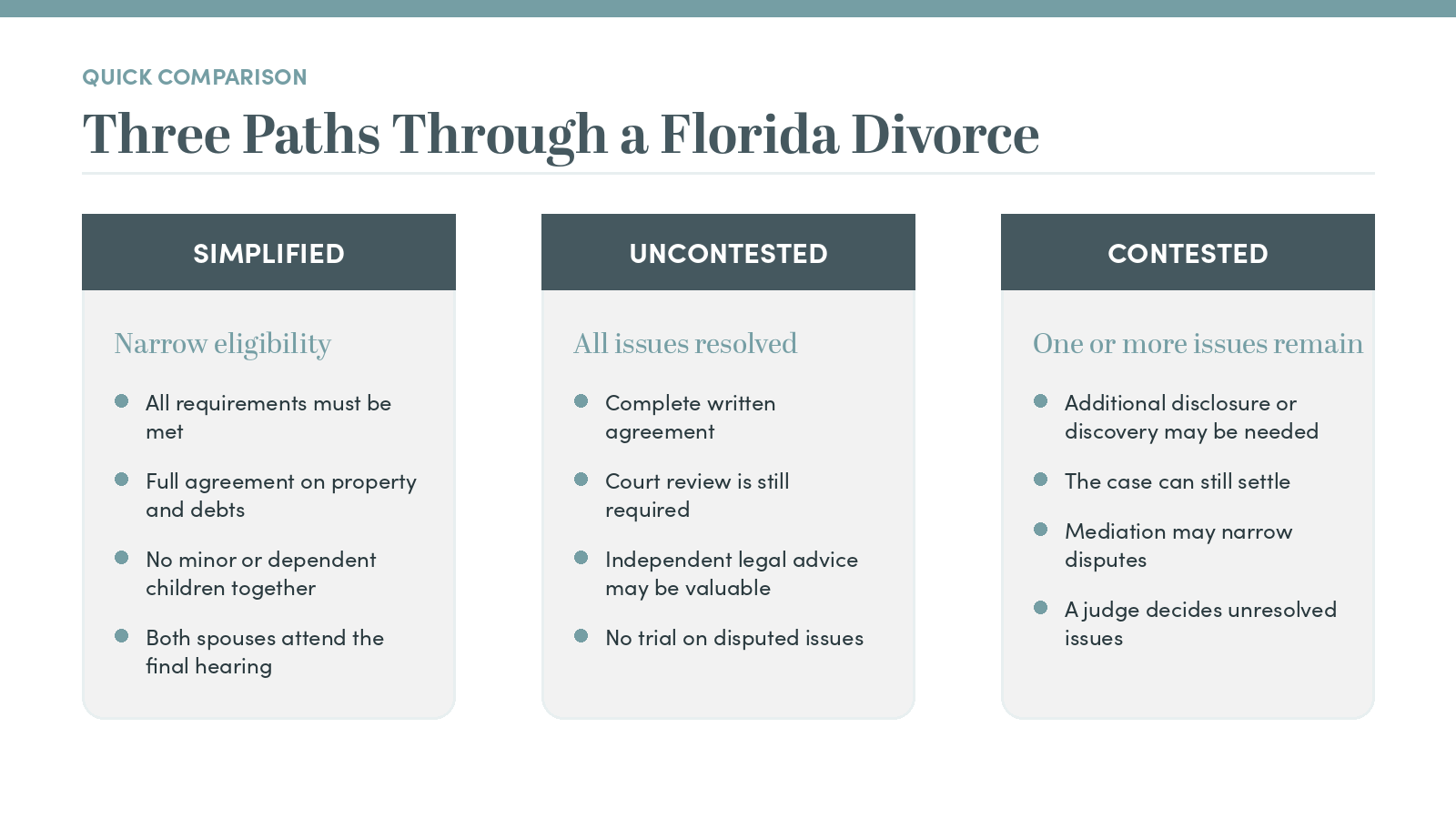
Florida’s simplified procedure is available only when the spouses satisfy all eligibility requirements. In general, they must agree that the marriage cannot be saved, have no minor or dependent children together and no pregnancy, agree on the division of property and debts, waive alimony, complete the required financial affidavits, and both attend the final hearing. It is designed for a narrow set of cooperative cases—not simply for any couple seeking a fast divorce.
A case is commonly described as uncontested when the spouses have resolved all issues and can present a complete written agreement for court approval. “Uncontested” describes the legal posture of the case; it does not mean the decisions were easy or that independent legal advice is unnecessary. Each spouse should understand the agreement before signing it.
A contested divorce includes at least one unresolved issue. The case may require additional disclosure, discovery, motion practice, expert assistance, mediation, or trial preparation. Contested does not necessarily mean hostile, and it does not mean the case must end in a trial. Many contested cases become fully or partially settled as reliable information is exchanged, and realistic options become clearer.
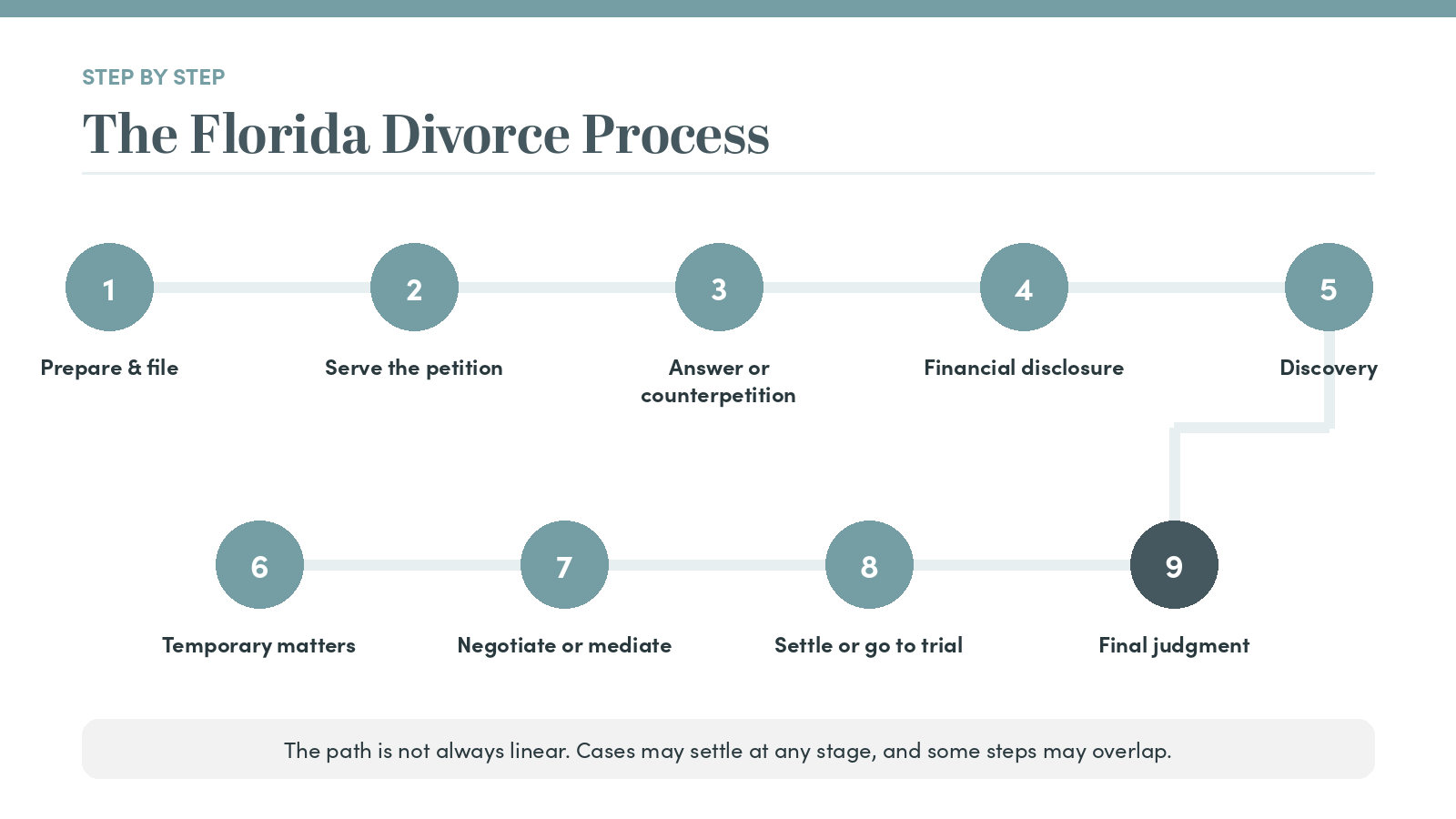
The petition opens the court case. It identifies the parties, alleges the legal basis for dissolution, and states the relief the filing spouse requests. Related documents may be required based on the circumstances. Accuracy matters: incomplete facts, omitted requests, or inconsistent information may complicate the case later.
Filing does not ordinarily provide notice by itself. The petition and summons must be formally served according to Florida law unless service is properly accepted or waived. Service establishes notice and starts important response deadlines. Informal delivery of papers is not automatically a substitute for valid service.
A respondent generally has 20 days after service to file an answer. The answer admits or denies allegations and states the respondent’s position. A respondent may also file a counterpetition requesting relief. If no timely response is filed, the petitioner may seek a default, but a default does not automatically eliminate every hearing or proof requirement.
Florida family cases generally require the parties to exchange specified financial information. The current mandatory-disclosure form states that responsive documents are generally served within 45 days after service of the initial petition. The exchange may include a financial affidavit, income records, tax returns, bank records, retirement information, debt documents, and other items required by the rule. Exceptions and permitted waivers are limited, and simplified dissolution cases are treated differently.
Disclosure is part of establishing a reliable factual record. It should be complete, organized, and truthful. Missing documents can generate requests, motions, expenses, and credibility concerns. How a particular asset, debt, or source of income is ultimately treated will be addressed in the separate guide devoted to that subject.
Mandatory disclosure is not always the end of information gathering. Discovery may include interrogatories, requests to produce documents, requests for admissions, subpoenas, and depositions. The appropriate tools depend on what is disputed, what information is missing, and whether third parties or experts hold relevant evidence. A focused discovery plan can help obtain necessary facts without creating needless cost.
A divorce may take months, yet a family may need workable arrangements before the final judgment. A party may request temporary relief when an issue cannot safely or practically wait. Because the standards and evidence depend on the specific relief requested, temporary support, parenting, property, fees, and safety matters will be discussed in their relevant Attorney’s Guides.
Settlement discussions may occur at any stage. Mediation uses a neutral mediator to help the spouses explore resolution; the mediator does not act as either spouse’s lawyer and ordinarily does not decide the dispute. Courts frequently require mediation before trial, and a full or partial agreement can narrow what remains for a judge. Strategy, preparation, confidentiality, and drafting considerations will be covered in the separate Attorney’s Guide to Mediation & Divorce Settlements.
If the spouses resolve every issue, their written agreement is submitted for court review and may be incorporated into the final judgment. If some issues remain, the court receives admissible evidence and decides them after a hearing or trial. A partial settlement can still save time by limiting the trial to genuinely disputed matters.
The final judgment legally dissolves the marriage and states or incorporates the binding terms of the outcome. Each party should read it carefully, obtain a complete copy, calendar every deadline, and complete required follow-up steps. The judgment is not merely a summary: failure to comply can create enforcement proceedings, while some provisions may be modifiable only under particular legal standards.
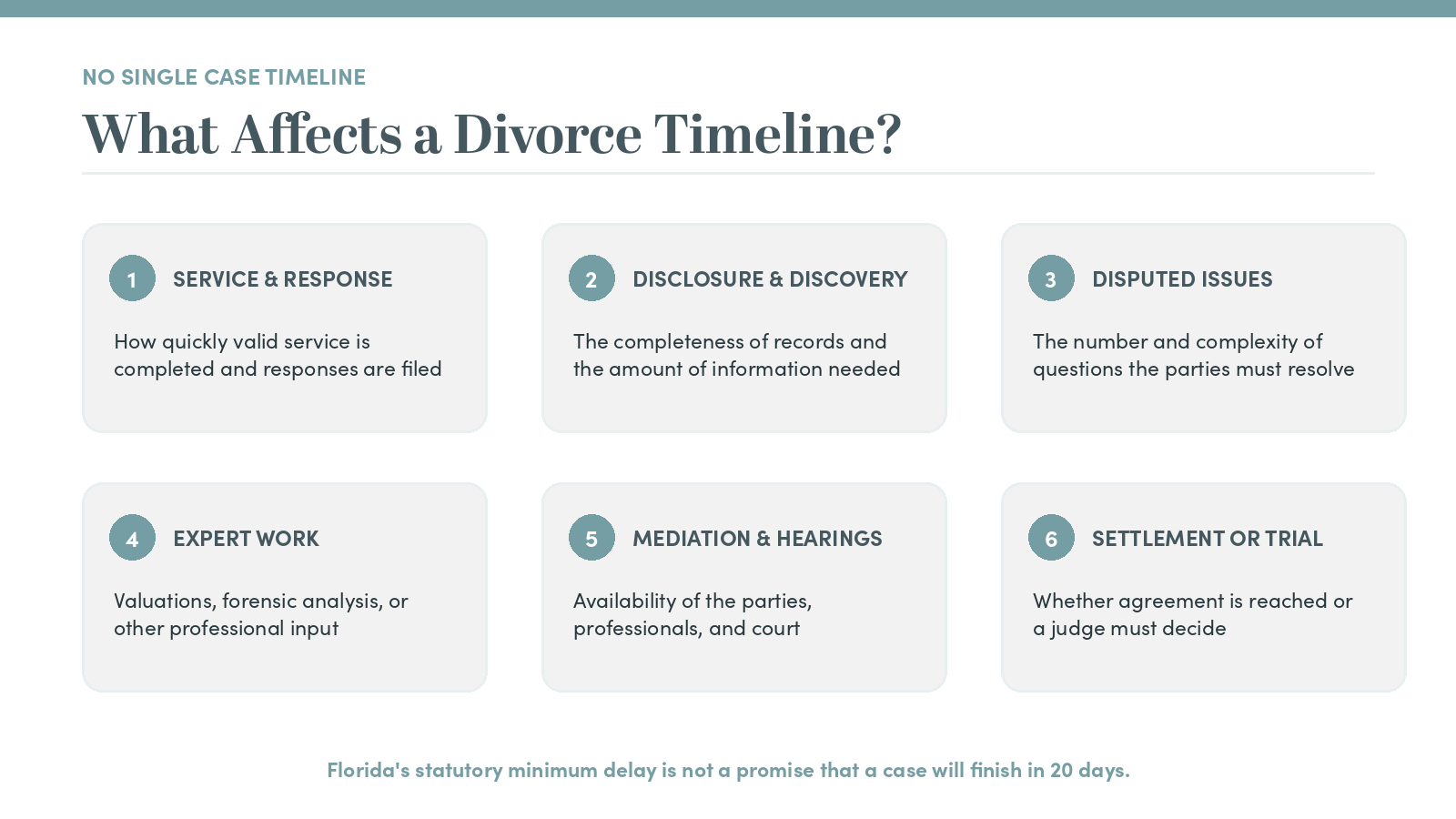
Florida law generally requires at least 20 days between filing the original petition and entry of a final judgment, although a court may shorten that period when the statutory standard is met. That is a minimum delay, not a promise that a case will finish in 20 days.
A straightforward, fully agreed case may move relatively quickly after documents, disclosure, and court requirements are complete. A disputed or complex case may take substantially longer. Timing can be affected by service, response and disclosure, the number of disputed issues, valuations or expert work, discovery, mediation availability, motion hearings, judicial calendars, and trial preparation.
Complexity does not come from the word “divorce”; it comes from the facts that must be documented and the decisions that must be made. Common complicating factors include:
Each factor may require a different legal and factual plan. The purpose of identifying complexity early is not to predict conflict; it is to choose the right process and preserve the information needed to resolve the case.
A productive consultation gives the attorney enough context to identify immediate concerns and explain realistic next steps. You do not need to arrive with a complete case file, but you should be ready to discuss:
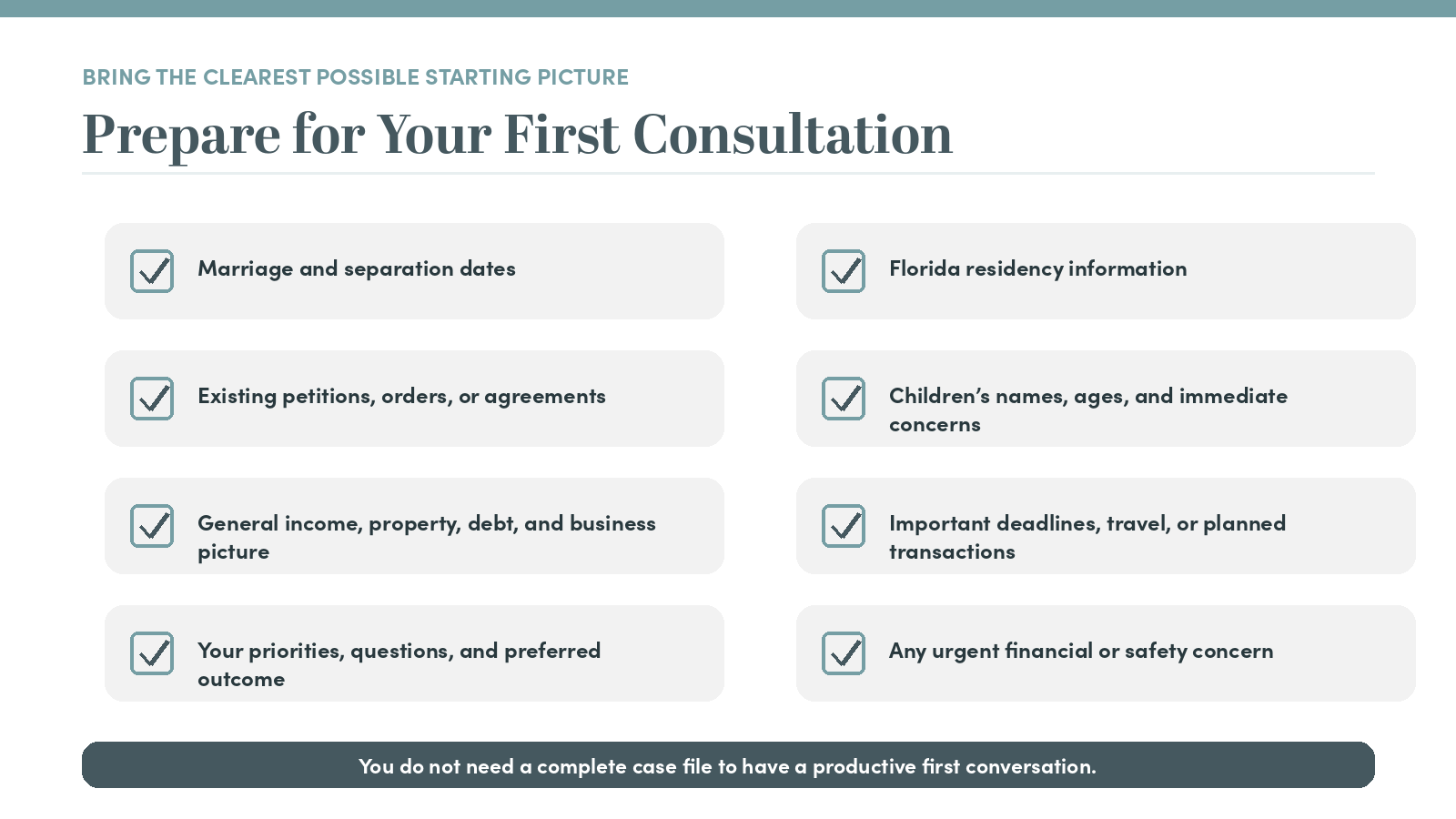
Be candid, including about facts that feel embarrassing or unfavorable. Attorney-client advice is most useful when it is based on the full picture. Do not send confidential details through an unconfirmed website or email channel before learning how the firm handles intake and confidentiality.
The following first-stage checklist helps organize the case without attempting to replace the formal disclosure requirements:
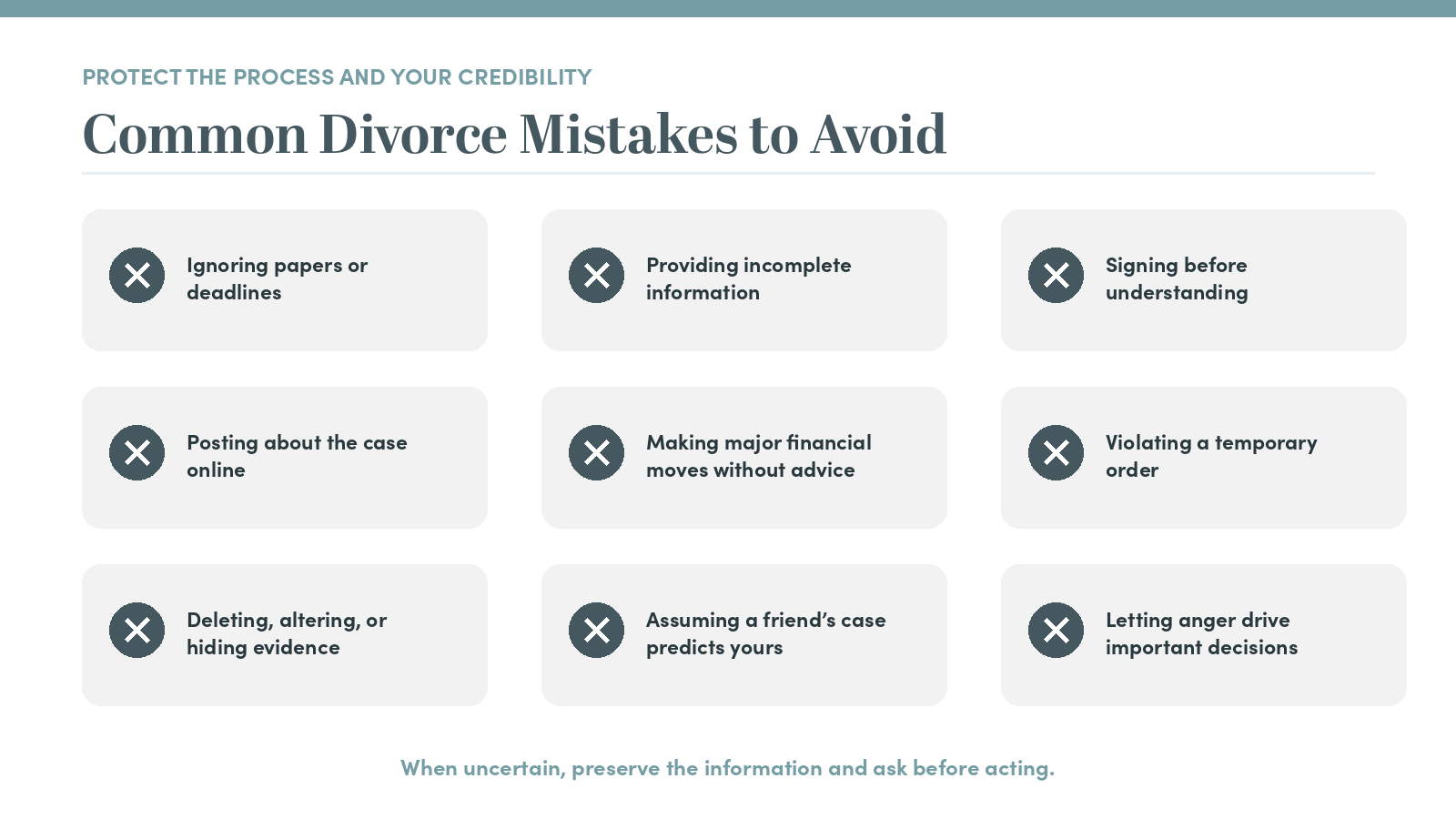
Preserve original records and electronic data. Avoid altering, deleting, hiding, or accessing accounts without authority. Your attorney can help determine what must be produced, what should be requested, and how sensitive information should be handled.
Consider obtaining legal advice before filing, immediately after service, before signing an agreement, or whenever a deadline, safety issue, interstate concern, significant transaction, or disputed fact may affect the case. Early advice can also be valuable before a final decision to divorce; understanding the process is not the same as committing to file.
For guidance tailored to your circumstances, speak with a Florida divorce and dissolution of marriage attorney who can evaluate the facts, explain options, and help plan the next step.
Readers who would like to review Florida’s official forms, statutes, or general consumer guidance may find the following resources helpful:
Please note: Official forms and general information are not a substitute for legal advice tailored to a person’s circumstances.
Grant J. Gisondo is a Board Certified Marital and Family Law attorney focused on divorce and related family-law matters. Board certification is The Florida Bar’s highest level of evaluation of an attorney’s competency and experience within an area of law. His representation is tailored to each client’s circumstances, objectives, and practical needs.
The Law Offices of Grant J. Gisondo, P.A. serves clients through offices in Palm Beach Gardens, West Palm Beach, and Stuart. To request a free consultation, call 561.530.4568 or email grant@gisondolaw.com.
Learn more about Grant’s Board Certification or view the attorney profile.
If you are considering divorce or dissolution of marriage in Palm Beach County, do not navigate the legal process alone. Contact our experienced Palm Beach Gardens Divorce Lawyer today to schedule a confidential consultation.