Law Offices of Grant J. Gisondo, P.A. Logo

(561) 530-4568

Call For Free Consultation

9:00-5:00 M-F

Saturday Appointments Available

Palm Beach Gardens (Main Office)

500 Village square crossing #103
Palm Beach Gardens, FL 33410
Phone: 561-530-4568

West Palm Beach

777 South Flagler Drive, Suite 800 - West Tower, West Palm Beach, Florida 33401
Phone: 561-530-4568

Stuart

1 SE Ocean Blvd., Stuart, FL 34994
Phone: 561-530-4568

9:00-5:00 M-F

Saturday Appointments Available

(561) 530-4568

Call For Free Consultation

Searcharea Opener Search
Sidearea Opener Menu
500 Village square crossing, #103 Palm Beach Gardens, FL 33410
Back to top
Grant J. Gisondo, P.A. – Family Law Attorney
The Attorney’s Guide to Child Custody and Parental Responsibility in Florida

The Attorney’s Guide to Child Custody and Parental Responsibility in Florida

Last reviewed: November 2026

When parents separate or disagree about raising a child, few questions matter more than who will make important decisions, how the child’s needs will be protected, and how disagreements will be resolved. Florida law addresses these issues through parental responsibility, parenting plans, and the child’s best interests—not a simple contest over which parent “wins custody.”

This guide explains how Florida courts approach parental decision-making, what shared and sole parental responsibility mean, which facts can influence an outcome, and how parents can prepare for a disputed case. It is intended for families in Palm Beach and Martin counties and elsewhere in Florida. Detailed time-sharing schedules, holidays, relocation, and parenting-plan design will be addressed in a separate Attorney’s Guide.

Child Custody and Parental Responsibility

Important: This guide provides general educational information about Florida child custody and parental responsibility. It does not determine the appropriate parenting arrangement for a particular family and does not replace advice from a Florida family-law attorney who has reviewed the court orders, relevant records, and the case's specific circumstances.

Florida Child Custody and Parental Responsibility at a Glance

  • “Child custody” is familiar language, but Florida statutes generally use parental responsibility and time-sharing.
  • Shared parental responsibility ordinarily means parents confer on major decisions; it does not necessarily mean equal time with the child.
  • The child’s best interests—not either parent’s preference—guide the court.
  • A rebuttable presumption concerning equal time-sharing is a separate issue from decision-making authority.
  • Evidence of abuse, domestic violence, neglect, or other safety concerns can materially change the analysis.

Understanding Child Custody in Florida

Parents often ask, “Who gets custody?” Florida’s statutory vocabulary is more precise. Parental responsibility addresses authority and duties concerning important decisions in a child’s life. Time-sharing describes how much time a child spends with each parent. A parenting plan connects these subjects and governs the parents’ relationship concerning the child. See Florida Statutes §§61.046 and 61.13.

This distinction matters. A parent may share decision-making authority without having an equal number of overnights. Conversely, a time-sharing schedule does not, by itself, explain which parent may make a major medical or educational decision. Parents should read the entire proposed order or parenting plan, rather than relying on shorthand such as “joint custody.”

Florida law does not establish a preference for mothers over fathers when creating or modifying a parenting plan. The court evaluates the child and family under the applicable law. A parent’s gender, income, or desire to be designated the primary caregiver cannot predict the outcome.

A parenting plan generally must address daily parenting tasks, time-sharing, health care, school-related matters, and communication. Even where parents agree, the court must consider whether the proposed arrangement satisfies legal requirements and the child’s best interests.

Parental Responsibility and Decision-Making

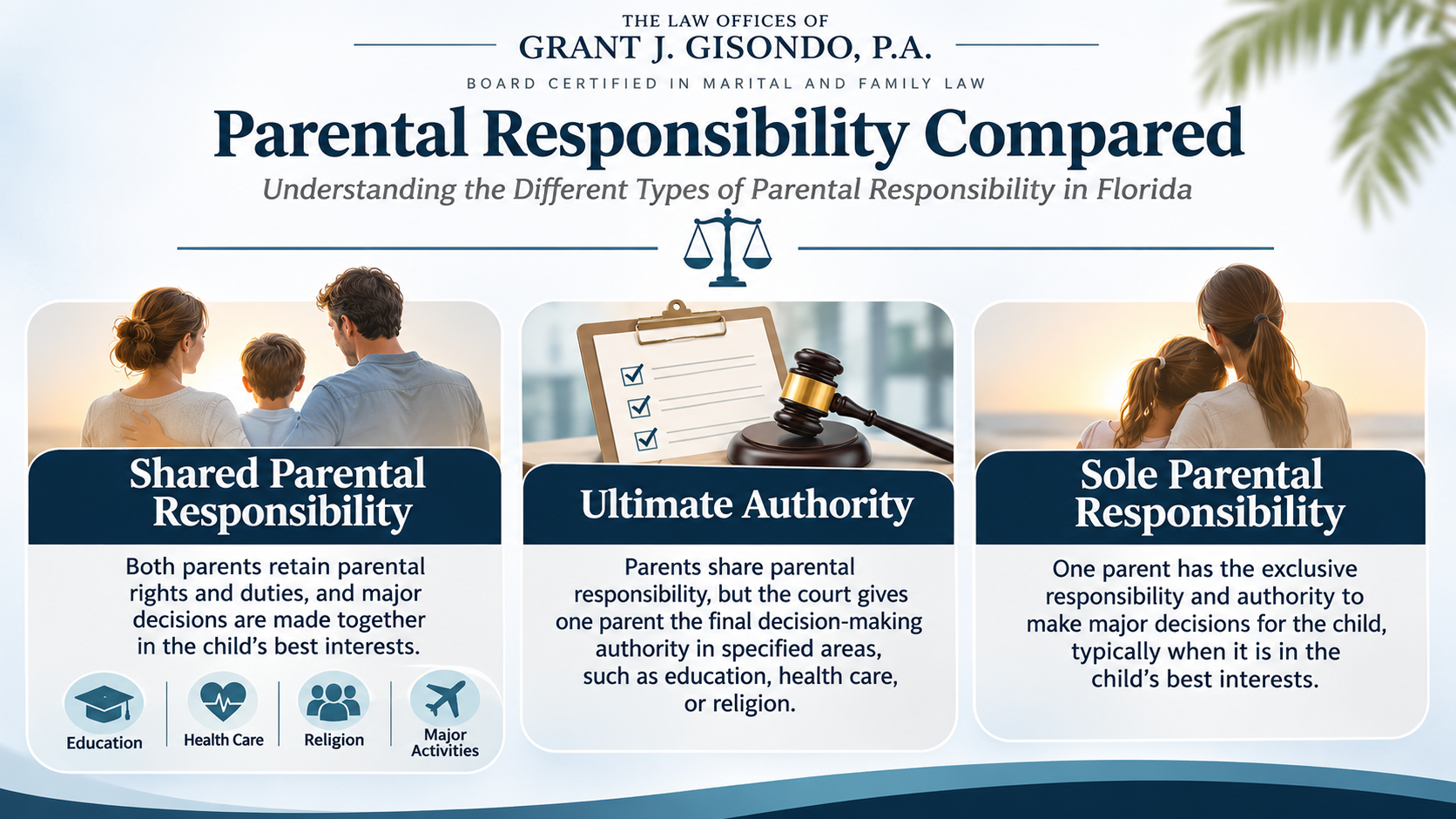
Shared parental responsibility is a court-ordered relationship in which both parents retain parental rights and responsibilities and confer so that major decisions affecting the child’s welfare are made jointly. Sole parental responsibility is a court-ordered relationship in which one parent makes decisions concerning the child. These definitions appear in Florida Statutes §61.046.

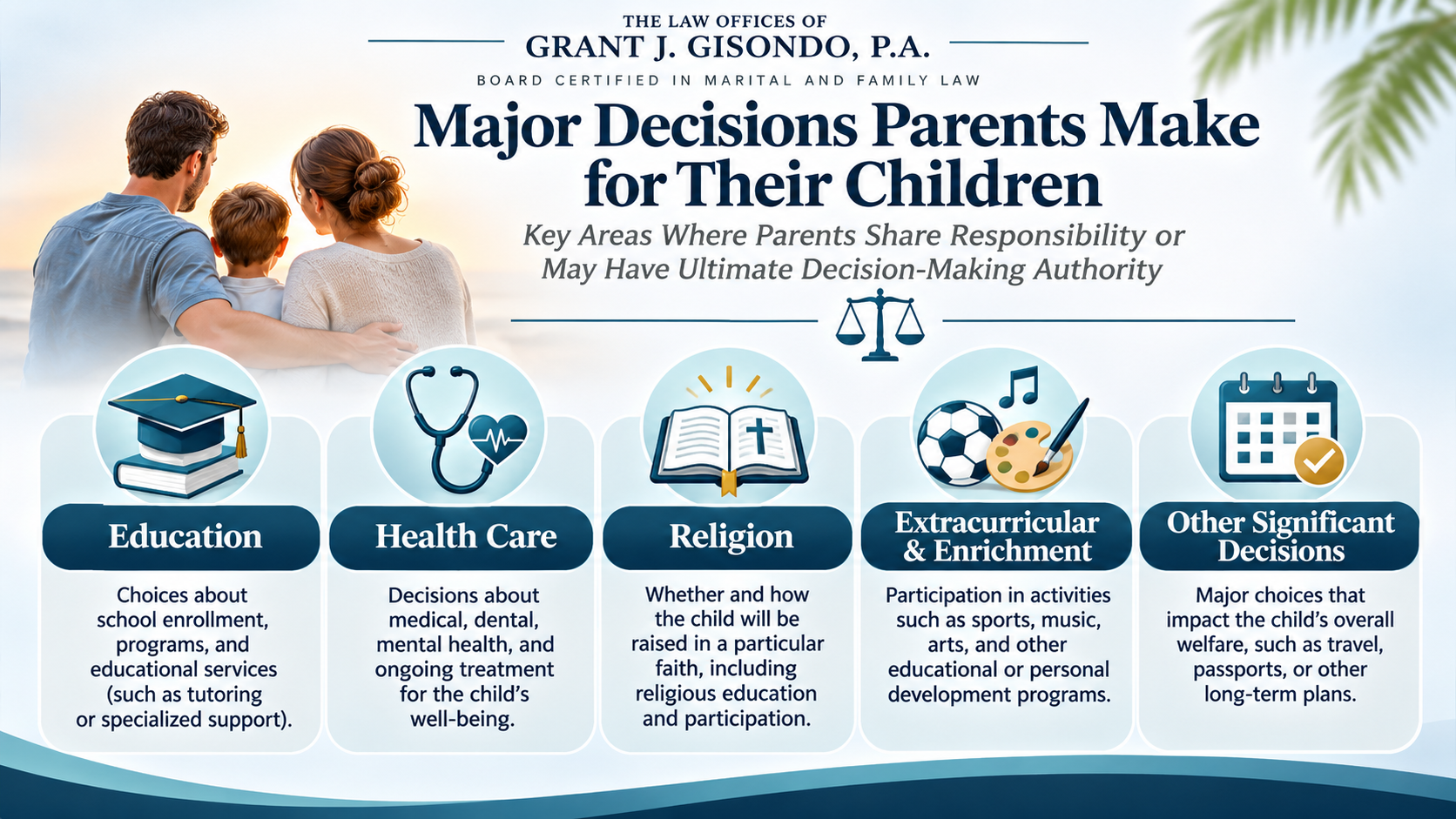
Major decisions may involve schooling, nonemergency health care, mental-health treatment, religious upbringing, or other significant matters relevant to the family. Everyday parenting decisions—such as ordinary meals, homework routines, and age-appropriate activities during a parent’s time—may operate differently from major decisions. The actual court order controls, and parents should not assume that every decision requires a joint signature.

Under section §61.13, a court may allocate ultimate responsibility over a specific area, such as education or health care, to one parent while otherwise ordering shared parental responsibility. This can be important when both parents are involved, but a recurring dispute makes a narrowly defined decision-maker necessary. It is not identical to awarding one parent sole parental responsibility over all major matters.

For health-care decisions, the current statute contains a specific provision regarding consent to mental-health treatment when shared parental responsibility is ordered, unless the parenting plan states otherwise. Because treatment decisions can be sensitive and fact-specific, parents should examine the exact language of their order and obtain legal advice before withholding or assuming authority.

Infographic titled Major Decisions Parents Make for Their Children listing Education Health Care Religion Extracurricular  Enrichment and Other Significant Decisions with a family image in the background

How Florida Courts Determine the Best Interests of the Child

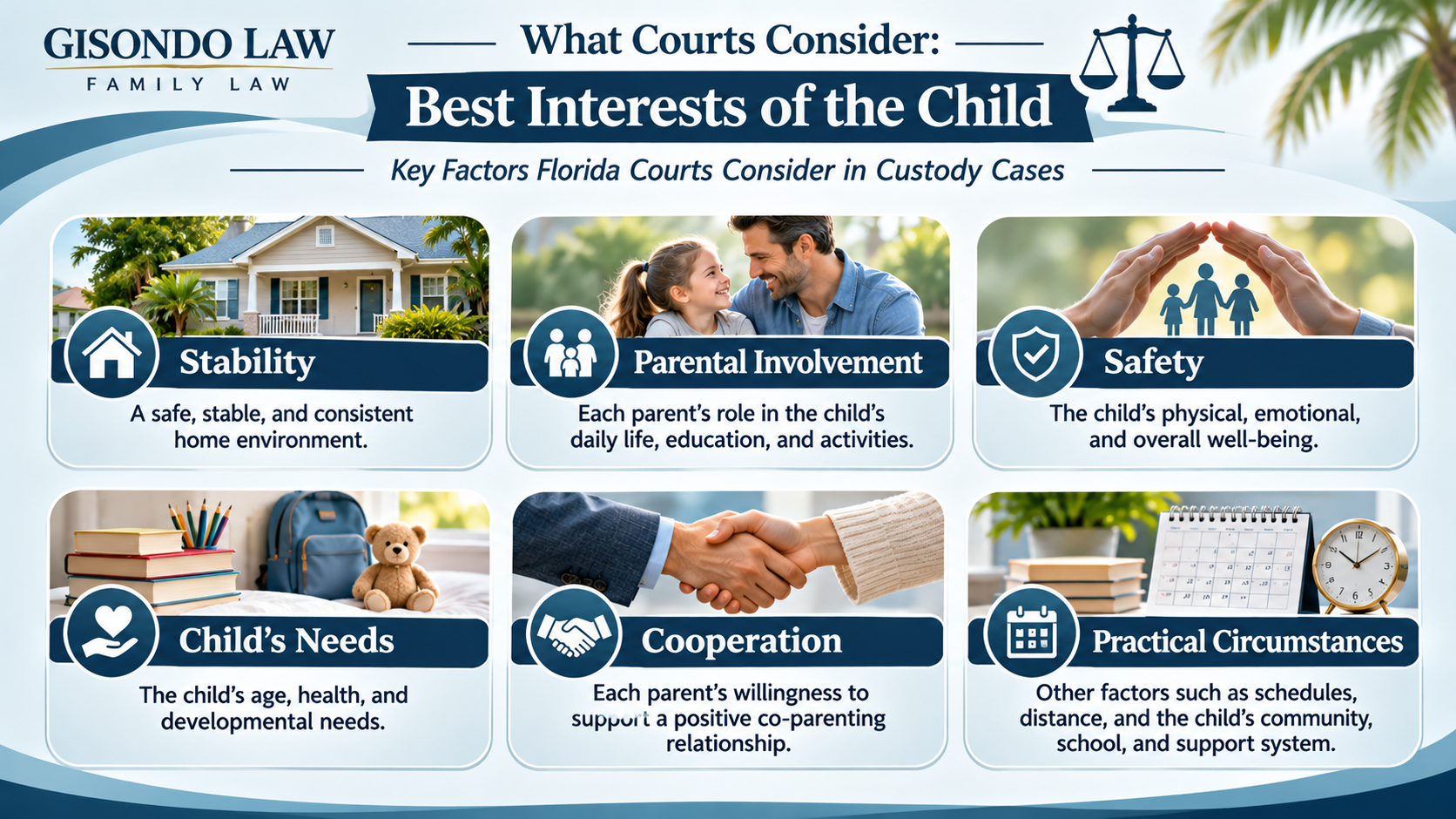
The best interests of the child are the primary consideration when a Florida court establishes or modifies parental responsibility or a parenting plan. Section 61.13(3) lists factors the court must evaluate; the list is not exhaustive. There is no mathematical scorecard under which one favorable factor guarantees a particular result. Evidence is considered in context, including the child’s developmental stage and the family’s history.

The statutory factors can be understood in several practical groups, but the categories below are an explanatory aid—not a replacement for the full statute.

Child-centered parenting
Whether each parent recognizes and acts on the child’s needs rather than prioritizing adult conflict; knowledge of the child’s life, interests, friends, providers, and developmental needs.

Stability and continuity
The child’s home, school, and community record; consistency of routines; the length of time in a satisfactory environment; and the practical feasibility of proposed arrangements.

Parental involvement and cooperation
Each parent’s historical parenting tasks, involvement in school and activities, ability to communicate, willingness to support the child’s relationship with the other parent, and ability to follow court-ordered arrangements.

Safety and well-being
Evidence of domestic or sexual violence, child abuse, neglect, abandonment, substance misuse, and a parent’s ability to keep the child safe and insulated from litigation.

Child-specific circumstances
The child’s physical, emotional, and developmental needs; relevant health considerations; and, where appropriate, a reasonable preference expressed by a sufficiently mature child.

Other relevant circumstances
Geography, travel demands, delegation of parenting responsibilities to others, and any additional evidence relevant to the parenting plan.

A child’s preference may be considered if the court finds the child has sufficient intelligence, understanding, and experience to express one. There is no single age at which a child automatically chooses a parent. The court also considers whether a parent has exposed the child to litigation, disparaged the other parent, or attempted to shape the child’s statements.

Parents can better prepare by documenting ordinary parenting involvement and specific child-related needs, rather than gathering only allegations about the other parent. School communications, treatment records, calendars, and respectful written messages may be more informative than broad assertions that one parent is “better.”


Best Interests

Shared vs. Sole Parental Responsibility

Florida law generally directs courts to order shared parental responsibility unless the court finds that sharing it would harm the child. The statute also authorizes sole parental responsibility when the applicable best-interest and detriment standards support that result. Courts may allocate ultimate authority for decisions in appropriate cases. These alternatives require attention to the evidence and the findings required by law.

Disagreement alone does not always make shared parental responsibility impossible. Courts may consider the seriousness, persistence, and impact of a dispute on the child. For example, parents who argue about scheduling but reliably exchange medical information present a different question from parents whose conflict repeatedly prevents necessary treatment.

Sole parental responsibility concerns decision-making; it does not automatically eliminate the other parent’s time-sharing or child-support obligations. Likewise, equal time-sharing is not the same as shared parental responsibility. Section 61.13 contains a rebuttable presumption that equal time-sharing is in the child’s best interests, but that presumption concerns the time-sharing schedule and may be overcome by the required evidence. The decision-making analysis remains distinct.

Banner for a law firm about Parental Responsibility with three panels Shared Ultimate and Sole authority over child decisions in Florida

When Child Custody Becomes Contested

A contested case arises when parents cannot agree on one or more legally significant parenting issues. Disputes may concern educational choices, treatment, a parent’s participation in important decisions, communication failures, or allegations that a proposed arrangement would harm the child. Some cases can be narrowed through attorney-assisted negotiation or mediation; others require evidence and judicial determination.

A useful first step is to identify the actual question the court must decide. “We cannot get along” may describe a relationship, but “we have missed three recommended appointments because consent was withheld” identifies a concrete child-related concern. Clear records and narrowly framed requests help an attorney assess appropriate relief.

Parents should avoid using a child as a messenger, withholding information to gain leverage, posting accusations on social media, or ignoring an existing order because the other parent has behaved badly. If an order is unworkable or safety is at issue, the safer approach is to seek timely legal advice about appropriate court relief rather than self-help.

Domestic Violence, Abuse, and Child Safety

Florida law requires courts to take evidence of domestic violence, sexual violence, child abuse, abandonment, neglect, and qualifying safety concerns seriously in parental-responsibility and parenting-plan decisions. A parent’s reasonable belief that the parent or child faces imminent danger may also be relevant under the statute, even when no separate case has been filed. The precise legal consequences depend on the evidence and the statutory provisions involved.

Certain domestic-violence convictions create rebuttable presumptions concerning detriment. A court may consider protective arrangements and may order sole parental responsibility when shared decision-making would be detrimental. The existence or absence of an injunction does not, by itself, resolve every custody question. Safety issues should not be minimized merely because a criminal charge was not filed.

If a child or parent faces immediate danger, contact emergency services or appropriate protection resources. For a non-immediate but serious concern, speak promptly with an attorney about documenting the facts, protecting confidential information, and seeking appropriate temporary or protective orders. Do not confront a potentially dangerous person to obtain evidence.

A safety-centered parenting arrangement should address how decisions, information exchanges, and necessary communication can occur without exposing the child or a protected parent to avoidable harm. The appropriate terms depend on the specific circumstances and any existing orders.

Guardian ad Litem and Parenting Professionals

In some contested matters, a court may appoint a guardian ad litem or involve an appropriately qualified professional to assist with child-related issues. Their duties, access to information, and recommendations depend on the legal authority for the appointment and the specific court order. A guardian ad litem is not simply the child’s personal attorney, and a professional recommendation does not automatically replace the judge’s responsibility to decide disputed issues.

Professionals may review records, interview appropriate individuals, observe family interactions, or provide specialized information within the scope of an appointment. Parents should cooperate with lawful requests, preserve relevant information, and ask counsel to explain confidentiality, costs, and the professional’s role before participating.

Not every custody case requires a guardian ad litem, evaluation, or expert. The question is whether the assistance is authorized and genuinely useful for the child-related dispute, considering its costs, scope, and potential impact.

Special Child Custody Circumstances

Unmarried parents may need to establish legally recognized parentage and obtain enforceable parenting orders. A biological relationship, a birth certificate, or an informal agreement does not always answer every question about legal rights or decision-making. A paternity case may therefore be a necessary part of obtaining a court-approved parenting arrangement.

Children with disabilities, chronic medical conditions, or significant educational needs may require particularly detailed decision-making provisions. Parents may need to address specialist appointments, individualized educational services, transportation to treatment, access to records, and how urgent decisions will be made.

Extended family caregivers and situations involving grandparents or other relatives can raise different legal questions. Florida law does not treat every relative as a parent with equal decision-making authority. A family facing guardianship, dependency, temporary custody, or third-party care questions should obtain advice specific to that legal framework.

Long-distance parenting and relocation can also affect a child’s life, but relocation law and detailed time-sharing arrangements deserve separate treatment. A proposed move should not be evaluated solely as a decision-making dispute.

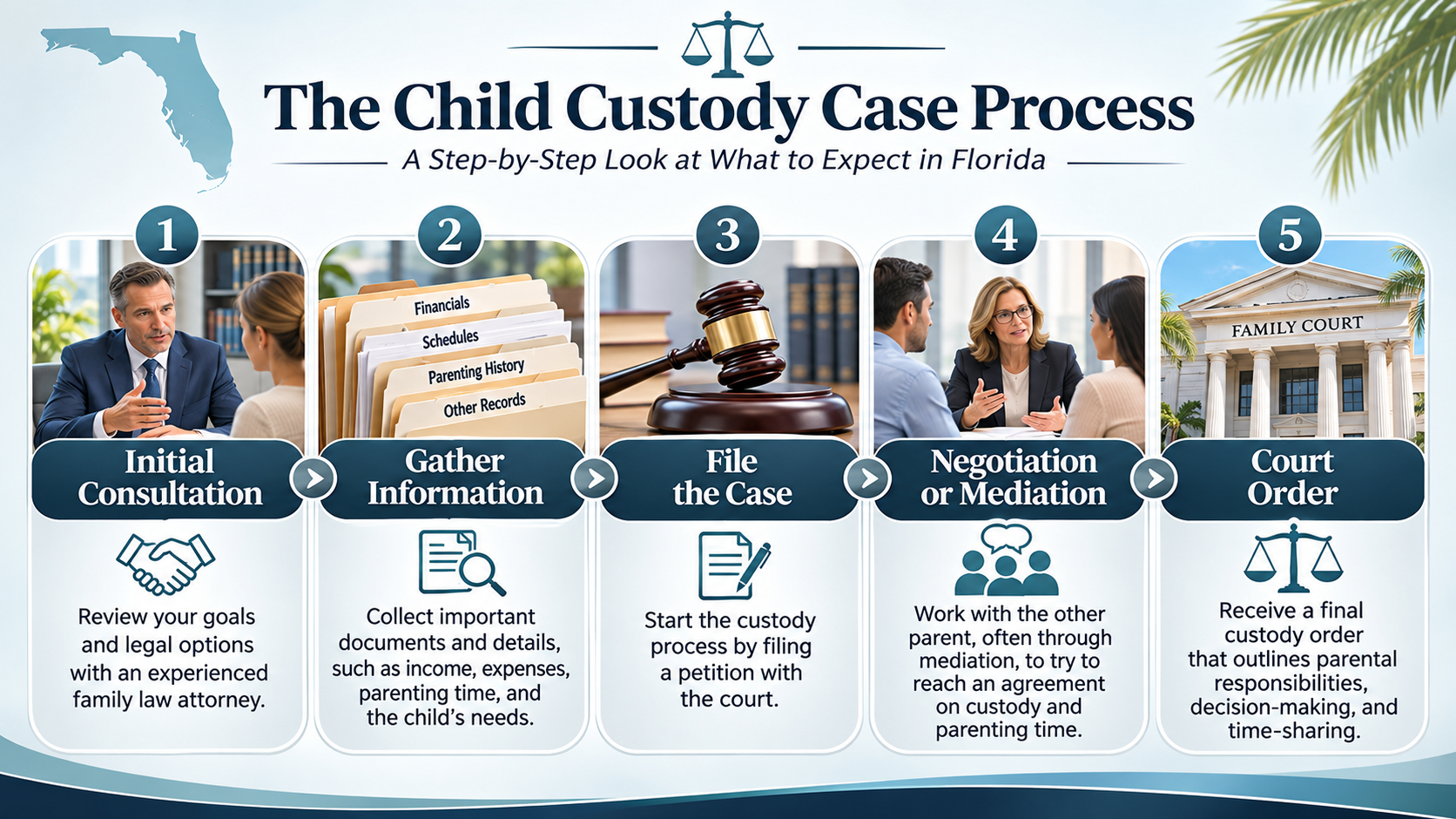
What to Expect During a Florida Child Custody Case

Initial consultation and case assessment
The attorney identifies existing orders, parentage, safety concerns, the child’s needs, the appropriate court, and the relief the client may lawfully seek.

Filing and service
The case may begin through divorce, paternity, or another appropriate family-law proceeding. Required documents and service rules depend on the type of action.

Temporary arrangements and information exchange
Where appropriate, parties may seek temporary relief, exchange relevant records, and address urgent or ongoing child-related needs while the case is pending.

Negotiation or mediation
Parents may resolve some or all disputes through a legally appropriate agreement. The court retains its role in reviewing matters affecting the child.

Hearing, order, and implementation
Unresolved issues may be decided after evidence is presented. The resulting order should be read carefully and followed; questions about enforcement or later changes require separate analysis.

These stages are an overview, not a promise that every case follows the same sequence or timetable. Court scheduling, local procedures, emergency circumstances, and the type of proceeding can substantially change the path.
Once an order is entered, a parent generally cannot modify parental responsibility or a parenting plan simply because preferences change. Section 61.13 establishes a substantial-and-material-change standard and a best-interests inquiry for modifications, subject to the precise law and facts. A future guide will address post-judgment modifications in depth.

Case Process

Preparing for a Child Custody Case

Preparation is most effective when it is organized around the child’s needs and the specific decisions in dispute. Keep records complete, dated, and truthful; preserve context rather than editing communications into misleading fragments. Ask your attorney what should be collected and how sensitive records should be stored.

  • Current court orders, prior parenting plans, and any pending case documents.
  • School records, teacher communications, attendance information, and relevant educational plans.
  • Medical, therapy, or specialist information lawfully available to the parent.
  • A calendar of parenting tasks, appointments, and major decisions, with dates.
  • Relevant written communications showing efforts to cooperate or resolve disagreements.
  • Records supporting specific safety concerns, if applicable, collected lawfully and without putting anyone at risk.
  • A concise list of disputed decisions, desired outcomes, and questions for counsel.

To help organize important decisions, consider using our Parental Responsibility & Decision-Making Worksheet for Florida Parents. This free resource provides space to document the child’s current needs, proposed decisions, each parent’s decision-making authority, available information, deadlines, and areas of disagreement. Organizing these details can help turn a broad conflict into manageable questions. Download the Printable Worksheet or Fillable Worksheet.

Common mistakes include treating the child as a witness to adult arguments, assuming an informal arrangement supersedes an order, overlooking the distinction between time-sharing and decision-making, and waiting too long to address urgent child-safety or treatment issues.

Desk calendar on a wooden table with a small potted plant in the background showing a monthly grid and spiral binding

Frequently Asked Questions

Do parents have to go to mediation?

Does a guardian ad litem decide custody?

Can a custody order be changed later?

Do unmarried parents have the same process?

Does domestic violence affect parental responsibility?

What if the other parent refuses to communicate?

Can a parent make an emergency medical decision alone?

What if parents agree on most decisions but not medical care?

When might a parent receive sole parental responsibility?

Can a child decide which parent to live with?

Is shared parental responsibility the same as 50/50 custody?

Does Florida favor mothers over fathers in custody cases?

What should I do to try to get sole custody?

What is sole custody?

About Grant J. Gisondo

Grant J. Gisondo is Board Certified in Marital and Family Law by The Florida Bar. The Law Offices of Grant J. Gisondo, P.A., assists families with divorce and family-law matters in Palm Beach and Martin counties. Families facing parental responsibility disputes can benefit from guidance focused on the applicable law, their child’s needs, and the facts of their situation.

Learn more about Grant’s Board Certification or view the attorney profile.

Schedule a Free Consultation

Discuss Your Child Custody Questions with a Florida Family Law Attorney

If you are concerned about parental decision-making, a contested custody matter, or the effect of an existing order, contact The Law Offices of Grant J. Gisondo, P.A., to discuss your circumstances and available legal options.

Schedule a Confidential Consultation

Legal Disclaimer

Legal Disclaimer: This guide provides general educational information about Florida law as of its last review date. It is not legal advice and does not create an attorney-client relationship. Laws, court procedures, and individual circumstances may change the analysis. Consult a qualified Florida family law attorney about your specific situation.